



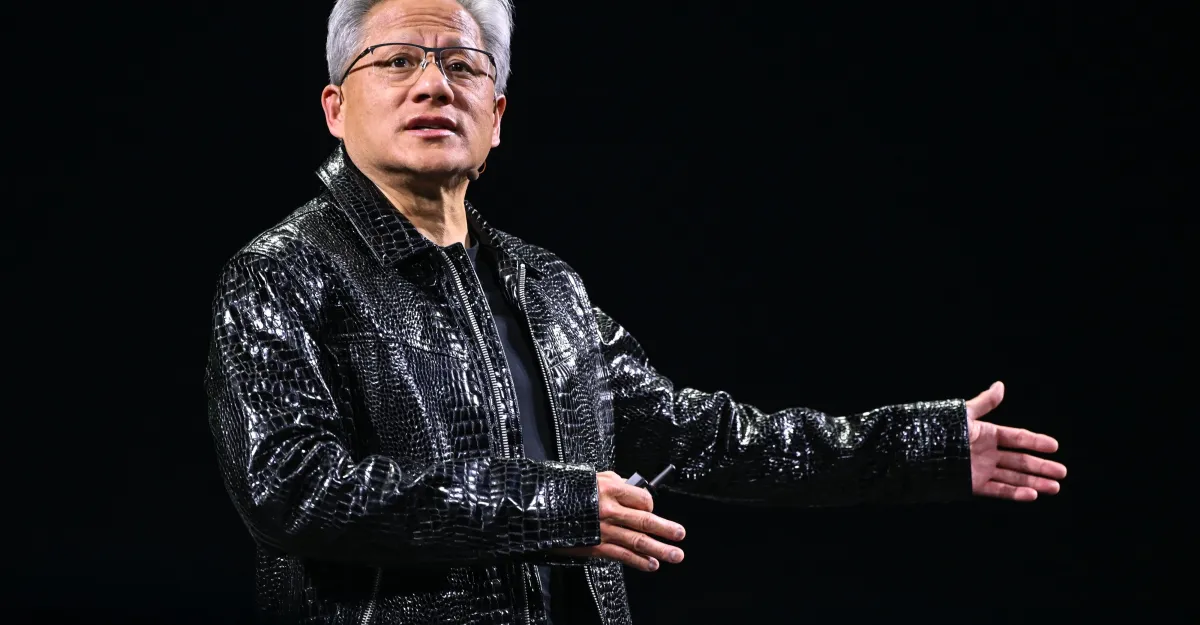
On January 6th, 2025, Nvidia CEO Jensen Huang got his rockstar moment at last. He strode triumphantly onstage, hand raised in the air, to the claps and cheers of a 14,000-person arena absolutely packed with influencers and fans, their faces awash in blue glow, as he made his entrance in a black leather jacket that shimmered in the stadium’s lights.
Few are cheering for Jensen Huang now. He has left Nvidia after seemingly enabling two chip smuggling scandals and allegedly having three extramarital affairs, including one with an alleged Chinese spy at the same time he was mingling with President Donald Trump.
The world is watching to see if this scandal might disrupt the entire US AI industry and perhaps destabilize the stock market along with it. That’s because Huang wasn’t merely running the first $5 trillion company, he was the visionary leader in control of the must-have GPUs powering the worldwide AI boom, part of a company that represents around 6 percent of the S&P 500 stock market index all by itself. And he didn’t plan for succession if he ever stepped down.
The 63-year-old once said he preferred to die on the job; he once suggested he’d work until he was 90 or 100, then carry on leading the company as a robot.
It’s not easy to replace Huang, partly because he had no deputies. Around 60 employees reported directly to the CEO. “He built the company around himself, and everything that happened there flowed through him,” says IDC analyst and former computing journalist Tom Mainelli.
“Jensen is Nvidia, and Nvidia is Jensen,” Jon Peddie, a computer industry analyst who’s been tracking Nvidia since its inception, tells me.
But Nvidia isn’t Jensen anymore. He has left the company he cofounded 33 years ago. It’s the end of an era, and not just for Nvidia — because Jensen Huang was Big Tech’s last true example of a visionary showman founder CEO.
“He was both the visionary and the tactical leader, the closest thing tech has had to Steve Jobs,” Moor Insights & Strategy chief analyst Pat Moorhead tells me.
Elon Musk didn’t exactly found Tesla and has quite the track record of broken promises, and Meta’s Mark Zuckerberg has proven to be neither visionary nor showman so far. Google’s Larry Page and Sergey Brin stepped away in 2019 as their company dealt with growing employee turmoil, leaving the company in the hands of Sundar Pichai, and both Microsoft and Apple have each passed the torch twice since the days of Bill Gates and Steve Jobs.
Some say Apple’s Steve Jobs broke the CEO mold, but he created a mold of his own. Huang was one of countless tech leaders who followed his example by introducing their products in keynote speeches, adopting a single recognizable piece of clothing like Jobs’ trademark black turtleneck, and even occasionally teasing “one more thing” for the surprise at the end of their presentations. In the newsroom, we’d sometimes joke about the Jobs wannabes; many were stiff suits who didn’t have the credibility to pull it off.
I thought Huang might be a Jobs wannabe, too, the first time I saw that he’d adopted a black jacket as his uniform. (It was not always a leather jacket; an earlier version was a Nvidia-branded softshell.) Huang later insisted on wearing a jacket even when the temperature was hot — more than once, I saw him sweat profusely rather than take it off. Unlike Jobs, he also held quite a few keynotes when he didn’t have much news to share; he liked to repeat the company’s previous accomplishments as if they were brand-new.
But even if Huang didn’t have the same gravitas as Jobs, he did have exciting tech up his sleeves and loved to demo it onstage. He knew how to get people excited about the future of visual computing with eye-opening gaming graphics, physics and lighting demos, and eventually image recognition, AI weather simulations, digital copies of real-world factories, and the robots that can virtually train in them.
His Nvidia tried to educate people about the how and why of GPUs, too; I still remember in 2008 when Nvidia invited the Mythbusters to demo the difference between serial processing and parallel processing by firing a 1,100-nozzle paintball gun to “paint” the Mona Lisa in one shot.
What I didn’t know back then: Huang was a visionary founder. He took Nvidia to fame and fortune through a series of tremendous bets.
In 1996, three years after he cofounded the company at a Denny’s diner, Nvidia nearly went out of business while working on a failed graphics chip for the Sega Dreamcast game console. But even though he didn’t deliver that chip, Huang personally convinced Sega to invest $5 million afterward, The Wall Street Journal reported in 2024.
Does Nvidia work without Huang?
Even without a named successor, analysts don’t think Nvidia is in big trouble yet.
“This is a stock shock, not a business shock, for the next year. The roadmap and manufacturing are locked in through 2027,” says Pat Moorhead, Moor Insights & Strategy. “The question is whether Nvidia keeps inventing at Jensen’s pace once those plans run out. The bigger risk than any rival chip is customers hedging during a vacuum. That is why the next CEO needs technical credibility, an operating model that doesn’t depend on one person, and a plan to protect CUDA.”
“Founder visionary, culture setter, leader, AI industry spokesperson etc., is the real loss. We don’t think anything changes strategically,” says Creative Strategies analyst Ben Bajarin.” The product roadmap is set and remains strong, and the next several generations are already in design, in tape-out or on order. NVIDIA is still the company best placed to ship its roadmap at scale, because it has spent years locking up the supply chain behind it, from leading-edge wafers and CoWoS-class packaging to HBM and the rack-level partners. That supply position does not walk out the door with one person.”
“He was the consummate showman, salesman, and visionary for NVIDIA, so he will be hard to replace,” says IDC analyst Tom Mainelli. “But the company’s technology road map is sound, and the team behind him is still there. Choosing the right person to replace him will be key, and there will undoubtedly be bumps along the way. But the company will survive.”
“Jensen built an exceptionally talented organization with a deep engineering bench, a mature, heavily-resourced software ecosystem, and strong customer relationships,” says Dave Altavilla, HotTech Vision and Analysis. “His departure undoubtedly leaves a leadership and strategic vision gap, but the technology, talent, and execution capabilities he helped establish aren’t going away. The real question is whether his successor can sustain that same long-term vision and willingness to invest ahead of the market.”
“No one in the company really wants to step into his shoes, so an outsider is going to have to be found,” says Jon Peddie of Jon Peddie Research. “Whoever that is will not be Jensen, won’t have the same ambitions, the same contacts and relationships, the same vision, or the same courage to make big, long-term bets. We’ve seen this in Apple, AMD, Intel, and other companies. So the stock will probably get battered around a bit until investors see some stability and fewer ‘what if’ questions.”
He then turned around and bet the company again on the Riva 128 PC graphics accelerator, an effort so ambitious he had to lay off over half of Nvidia’s roughly 100 staffers, skip the prototyping stage, and rush it straight to production, and he still only had one month of payroll left by the time it shipped, The New Yorker wrote in 2023. Thankfully, it was a success, selling a million units in just four months and paving the way for both the GeForce GPU and a long-term relationship with chip fabricator TSMC.
Roughly eight years later, Huang decided it wasn’t enough to be the leader in PC gaming graphics alone. He bet the company’s entire gross profit, he told podcaster Lex Fridman, on shipping a new feature inside those graphics cards that no one had asked for: CUDA. It was the ability to use a GPU for other kinds of computing tasks beyond graphics, and Huang said it increased the cost of every GeForce graphics card by 50 percent.
“Originally there was no market or market demand for it. It was almost as if they built it because they could,” says Peddie. “Jensen had the vision for what it could be and the courage to pursue it in spite of the opinions of others.”
“NVIDIA was effectively investing in a computing platform that extended far beyond graphics, with no guarantee of a near-term return,” says HotTech analyst Dave Altavilla.
“Huang saw that a GPU was really a parallel computer that happened to render graphics. CUDA turned that insight into a platform, and it’s why NVIDIA was ready when AI arrived,” Mainelli tells me.
It was a bad time for graphics cards to suddenly cost more. When the Great Recession hit in 2007–2009, and Nvidia laptop graphics chips also started failing due to design defects, the company lost 80 percent of its market value.
But Huang believed in CUDA enough to invest even more. “He literally handed out high-end NVIDIA GPUs to researchers at industry conferences, while the company seeded universities like Stanford with hardware to encourage development on its platform,” says Altavilla. And by 2012, Nvidia’s potential for AI had started to emerge.
That’s when University of Toronto researchers used Nvidia GPUs to train a prize-winning image-recognition neural network called AlexNet, which is widely credited for sparking the AI revolution.
Not all of Huang’s visions panned out the way he publicly expected. That AlexNet demo directly led to Huang’s bets on chips for self-driving cars, he said, but he didn’t exactly predict AI — CUDA was instead thought of as better and more affordable supercomputing for researchers and scientists. In 2013, I also wrote about how his grand plan for the future of the company relied heavily on putting Nvidia chips in your phone, which didn’t pan out.
But that bet on ARM-based phone chips did put Nvidia inside every Nintendo Switch and may have helped make future “AI superchips” possible — the latest Nvidia AI server chips have ARM CPU cores. And in 2022, the leaders of the AI revolution launched the most groundbreaking AI tech yet on Nvidia hardware: ChatGPT. Six years earlier, Huang hand-delivered Nvidia’s first purpose-built AI workstation to OpenAI, and by 2022 Microsoft had strung together tens of thousands of Nvidia A100 GPUs to handle the load.


“Every time competitors got close, he moved the fight up a level: the chip, then the server, then networking with the $6.9 billion Mellanox deal, then the full rack, all tied together by CUDA,” says Moorhead. “The speed came from how he ran the company,” he adds. “Decisions that took other companies four weeks took Nvidia four days.”
“Decisions that took other companies four weeks took Nvidia four days.”
As Nvidia’s fortunes and profit ballooned — thousands of dollars in pure profit every single second! — and as it became clearer that AI would reshape the world in one way or another, something strange happened. Huang became a celebrity. In summer 2024, The Wall Street Journal and social media chronicled that he received a hero’s welcome in his birthplace of Taiwan. He stopped over and over to sign autographs, including one on a woman’s chest.
In person, at presentations, and in the company’s investor Q&As, I saw the tone shift. People began treating the leather-jacketed man like an actual rockstar instead of a wannabe rockstar, asking for photos and autographs and complimenting him rather than asking tough questions.
It felt like he’d attained Steve Jobs’ infamous “reality distortion field” at last — until he popped that bubble himself with his infidelity.
But one fewer reality distortion field in the world isn’t necessarily a bad thing, and as Apple has shown, a company doesn’t go bust just because its charismatic founder is gone. Tim Cook made Apple the most profitable company in the world. The question now is: who for Nvidia?
“He was the king,” says Peddie. “Make no mistake – it was the Jensen Huang company. He called all the shots, took all the glory, and shouldered all the blame.”