



Then there’s the question of whether SMART could worsen the chronic shortage of air traffic controllers. The FAA hopes that the technology lessens the shortage by requiring fewer workers; other industries, though, have yet to see AI-generated efficiencies actually materialize. Even if the software doesn’t directly replace humans, the efficiency could be used to justify a workforce reduction. In May, the FAA reduced its staffing target for active air traffic controllers from the 2024 goal of 14,633 down to 12,563, citing “modern staffing models and scheduling tools.”
Some are more optimistic than others. “I think the SMART program is an important improvement,” Schiavo says. “No one wants the current aviation environment with midairs, runway incursions, myriad near misses, delays, groundings, loss of separation, and long taxi or clearance wait times.”
Michael McCormick, a professor of air traffic management at Embry-Riddle Aeronautical University, also sees advantages to a predictive tool. “When you have the computing capability to look at the entire trajectory of the aircraft, you can see where the conflicts are going to be,” he says. “And the general axiom in air traffic control is that the sooner you know about a potential conflict, the less effort is required to resolve it.”
That sounds great, but building machines that do a good job most of the time is one thing; machines that can function at the level of reliability required by aviation is another. At present, researchers are focusing on so-called deterministic neural networks—models trained offline whose weights are frozen before being deployed in the real world. These can’t hallucinate, but they may harbor other risky failure modes. In a 2021 paper, Darren Cofer, a researcher at Collins Aerospace, pointed out that when such systems find themselves in situations they haven’t encountered before in training, they can generate “unexpected (and potentially dangerous) outputs.”
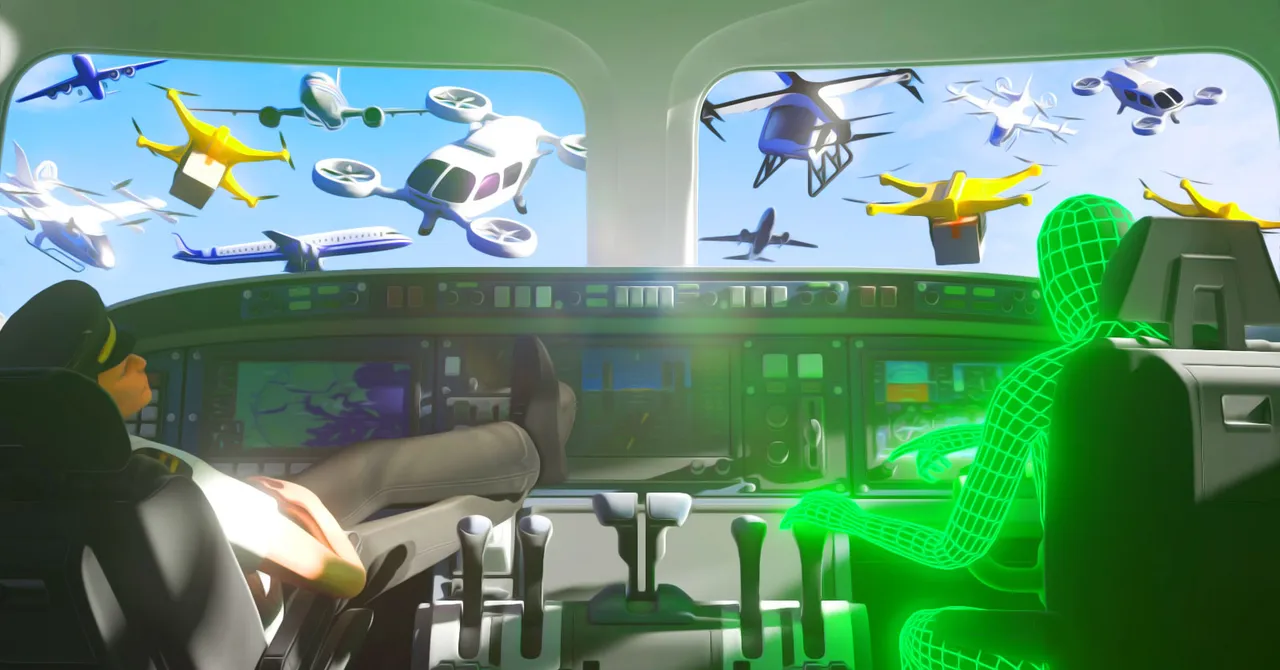
The stakes will be even higher when AI software starts making real-time air traffic control decisions, which will start in airspace devoted to autonomous aircraft. According to McCormick, that’ll most likely be select corridors near drone hubs and eVTOL vertiports. With swarms of robot aircraft zipping back and forth, things will be too hairy for human pilots and controllers. “The objective is not to use traditional air traffic control,” he says, “because it would overwhelm the national airspace system if it tried to handle that volume and complexity of airframes moving around.”
With two systems working side by side—one with human decisionmakers, the other with AI—we’ll have a real-time basis to compare the performance of both approaches. Any computer-based system can potentially be hacked; any AI system creative enough to ideate novel solutions could also hallucinate crucial details. Without a human in the loop, seemingly obvious mistakes might go unnoticed until it’s too late.
Let us know what you think about this article. Submit a letter to the editor at [email protected].