



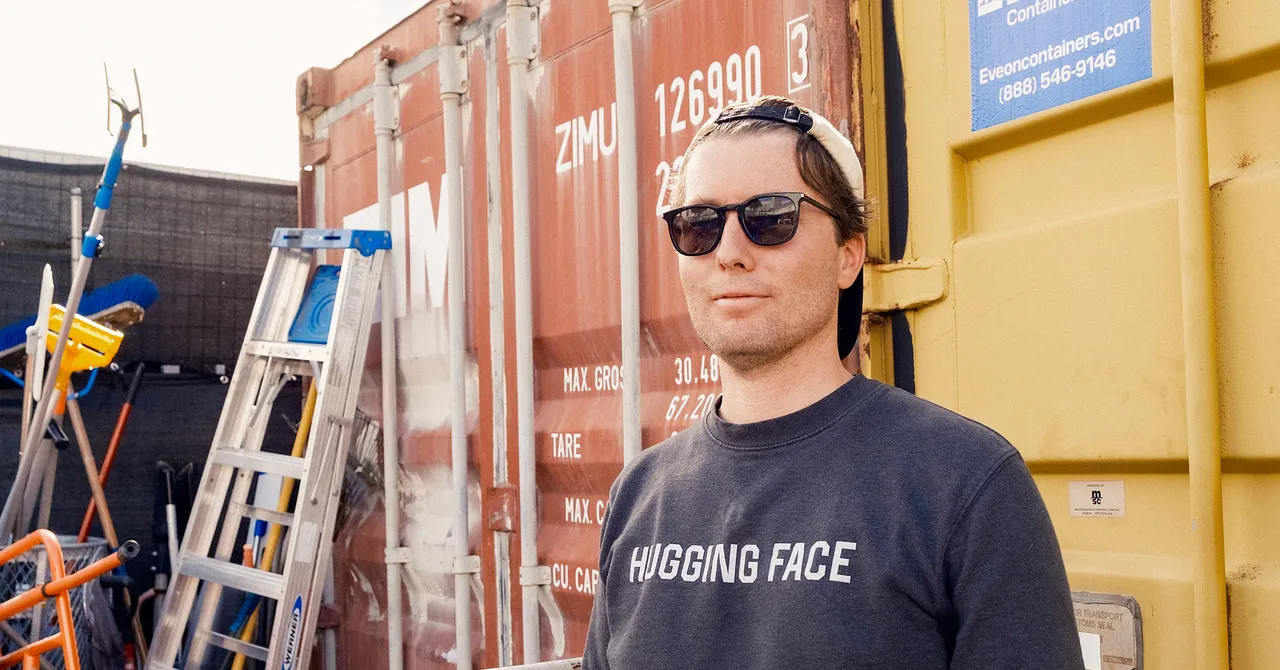
Clément Delangue, CEO of the open-source AI company Hugging Face, may go down in history as one of the first people ever attacked by a rogue AI agent. His company, which hosts millions of AI models and datasets, was breached in July when hundreds of agents being tested by OpenAI broke free from their sandbox and went on a hacking spree.
As the agents worked at superhuman speed to probe and exploit systems, Hugging Face confronted a bewildering deluge of data. The company’s engineers were only able to analyze the attack by using an open-weight model called GLM 5.2 from a Chinese company called Z.ai.
Delangue moved to the US more than a decade ago, “barely speaking English,” and built Hugging Face into a platform that supports tens of millions of AI developers. The fresh-faced Frenchman, who dresses even more like a skater than most AI execs, says the summer attack highlighted the value of open-weight models, which unlike ChatGPT or Claude can be downloaded and run by anyone.
Despite championing the democratization of AI, however, Hugging Face was acquired by one of the industry’s biggest players, Nvidia, for $12.93 billion in September. When I caught up with Delangue recently, that was the subject of my first question.
This interview has been edited for length and clarity.
WILL KNIGHT: Why sell to Nvidia?
CLÉMENT DELANGUE: We need more resources to give open-source AI a chance. It has grown really well in the past few years and has become a really credible alternative to closed-source APIs. But the field is still dominated by closed-source.
We’re gonna have the Anthropic IPO in a few weeks. They basically went from zero to a top five or top 10 most valuable company in the world in a few years. I don’t think that’s ever happened before.
Does Anthropic’s IPO suggest the closed approach is winning?
It’s hard to say. I’ve always said that there is a very strong natural tendency for AI to concentrate capabilities and wealth. People haven’t internalized how much of the future compute capacity has already been reserved by a few companies. Talent, compute, resources—these all fuel the natural tendency for AI to be dominated by a few closed-source labs.
Let’s talk about the attack. When did you first realize Hugging Face was being hacked by a group of AI agents?
At the beginning, it didn’t go to the top of our priority list. It just wasn’t bad enough to really trigger that. The goal was pretty narrow and wasn’t deemed to be very dangerous or damaging. But it was raising questions. Especially the number of actions taken compared to the narrowness of the goal. It was surprising to us, and we couldn’t really fit it into a familiar pattern. That’s why we started investigating.