



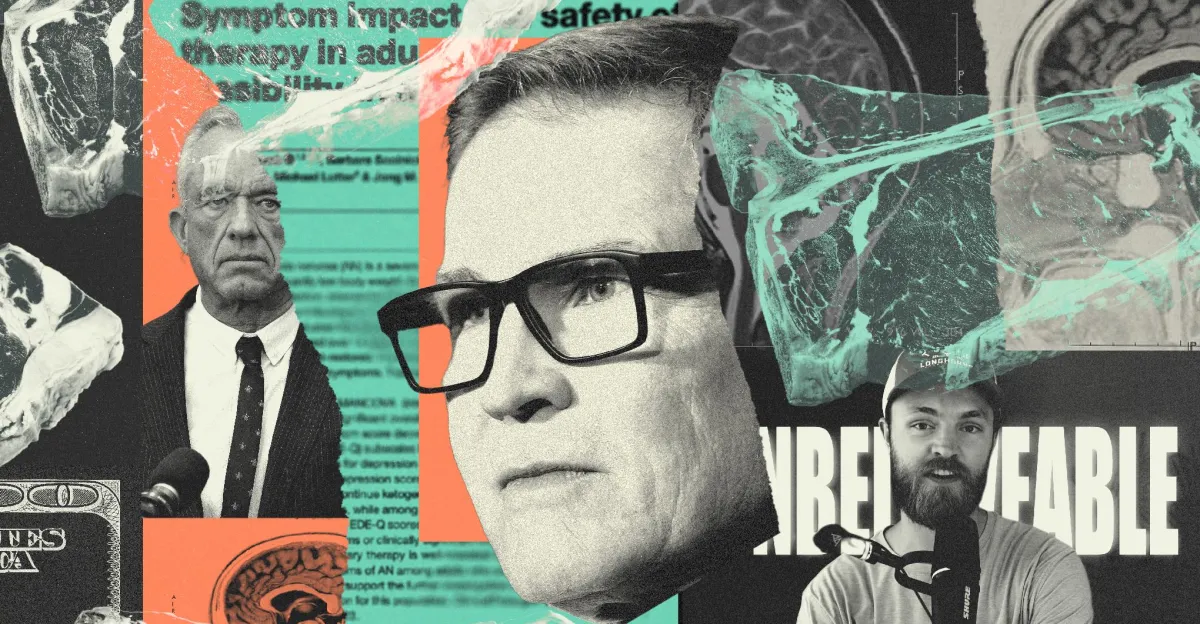
In a dark room, a man with a camera makes his pitch: Therapy isn’t the first treatment you should get if you have anorexia or bulimia, he says. He’s in his late 20s, wearing a backward camo baseball cap and a silver chain. “Instead of going straight to the therapy, let’s do a keto diet where we encourage you to eat as much as you want” — all while limiting your carbohydrate intake to 30 grams a day. He tells his viewers that this shift will force your brain to use a different fuel source, and “all those defective neural pathways that were causing you to engage in that eating disorder, they heal up and they start to work correctly.”
“Suddenly, that eating disorder is not there anymore,” he says.
There is no evidence to support the man’s claim. In fact, most of the psychiatrists and nutritionists The Verge spoke with for this story said that treating an eating disorder with a restrictive diet is just too risky.
“This intervention right now would be reasonably viewed as dangerous or high risk,” says Kylie Jeffrey, a nutrition scientist at Duke University. “I think that’s a danger,” says Cynthia Bulik, a clinical psychologist and the founding director of the University of North Carolina’s Center of Excellence for Eating Disorders. “Don’t try this at home.”
If you or someone you know has an eating disorder or is navigating a difficult relationship with food, exercise, and/or body image, help is available.
ANAD helpline: Call 1-888-375-7767 for emotional support and treatment referrals.
Crisis Text Line: Text HOME to 741-741 from anywhere in the US, at any time, about any type of crisis.
988 Suicide & Crisis Lifeline: Call or text 988 (formerly known as the National Suicide Prevention Lifeline). The original phone number, 1-800-273-TALK (8255), is available as well.
As with many spurious health claims, this one didn’t come out of nowhere. The ketogenic diet is a high-fat, very low-carb diet that can cause people to go into “ketosis,” a state in which a person’s cells begin to burn fat, in the form of ketone bodies, instead of sugar. And researchers have started to study its use to treat anorexia nervosa. But because the research has barely begun, no one knows if this will work. And although some researchers think that trying to treat a disease involving food restriction with a limited diet might be dangerous, others are excited about the possibility of new treatments. They just want to see data from large, rigorous clinical trials to make sure that keto actually is a treatment.
On the internet, however, the ketogenic diet is already being promoted as an “effective” way to treat eating disorders. The man in the camo hat — his name is Matthew — is an important part of how that message has spread. Matthew’s audience is small. He has a few thousand followers on YouTube and Instagram. And the video in which he talks about eating disorders going away on keto has a little under 1,000 views on YouTube at the time of reporting. But it would be a mistake to evaluate his reach and influence solely based on his view counts. Because in the “Make America Healthy Again”-coded world of ketogenic diet influencers, Matthew is about as connected as it gets.
Matthew’s father is David Baszucki, the CEO and cofounder of the gaming platform Roblox. It’s the largest gaming platform in the world, with more than 100 million daily active users, most of them kids and teens (though there are plenty of adults, too). Thanks to Roblox, his net worth sits somewhere between $3 billion and $5 billion. And since 2021, David and his wife Jan Ellison Baszucki have put more than $105 million toward funding research, clinical care, and advocacy work that revolves around metabolic health, with more than $55 million dedicated to the use of a ketogenic diet to treat mental illness. They’re considered big players in this burgeoning space.
I first heard about the Baszuckis’ philanthropic interests in December 2025, when a podcast producer emailed me to ask if I would be interested in hosting a new show funded by a nonprofit organization. Over the phone, I learned that the podcast would mainly be covering a new study by a researcher named Guido Frank in which scientists had investigated the use of the ketogenic diet to treat anorexia nervosa. I also learned that the nonprofit that had funded the study, Baszucki Group, would also be funding the podcast. I declined to participate in the project.

The Baszuckis feel strongly about the impact of their philanthropy. “Baszucki Group has been the catalyst for a growing body of research targeting metabolic root causes of mental illness with therapeutic ketogenic interventions,” Baszucki Group spokesperson Maura Siefring wrote in an email to The Verge.
Matthew’s own compelling story is what got his parents interested in this kind of philanthropy — though that story has never included an eating disorder. “I healed my own bipolar disorder using a ketogenic diet,” Matthew says in many of his videos. “And now I’m on a mission to help other people recover.” Keto is a specific area of interest for Matthew, who highlighted his parents’ role in funding this research in a June video called “This Keto Anorexia Study Just Broke the Internet.”
“Broke the internet” is something of an overstatement. Still, Dr. Guido Frank, a psychiatrist at the University of California, San Diego, and the lead author of the trial, published in Communications Medicine, tells The Verge, “I am extremely hopeful that this could be — this is a little bit dramatic, but a game-changing intervention … I haven’t seen such good results throughout my whole career.”
In the small, 14-week study, which Frank’s team conducted with a $235,000 donation from the Baszuckis, researchers recruited 22 people who were either slightly underweight or weight “normalized,” meaning that they were neither overweight nor underweight. The goal was to see if it was safe and feasible to use the ketogenic diet as an anorexia treatment. Of the 18 people who completed the study, “none of them lost weight,” Frank says. But what’s remarkable, he says, is that 12 of those 18 participants experienced a decrease in their eating disorder and depression symptoms, such that they no longer met the diagnostic criteria for anorexia nervosa. “This is not something that you typically see in the other available treatments that we have.”
The study didn’t require that participants receive any form of therapy during the trial period, and if you asked Matthew, he might tell you that’s a good thing. His videos frequently proclaim the dangers of conventional psychiatric treatments. “There’s a malicious force trying to cripple us, trying to feed us this snake oil,” he says in a video posted in March. That seems to be a common refrain among ketogenic diet influencers.

“There are a lot of people who are going to use metabolic psychiatry and the ketogenic diet to disparage psychiatry in a way that’s wholly inappropriate,” says Dr. Drew Ramsey, a nutritional psychiatrist. “And that’s not helpful to patients and families because there are lots of people out there currently in full remission from their mental illness with the treatments that we have,” including therapy and medications — “millions and millions of people.”
For every dollar the government spent on research in the US, private funding sources — namely private industry — spent more than four, according to a 2022 estimate from the National Science Foundation. But that statistic hides an important fact about the kind of research that the federal government funds. The US government is the single largest source of funding for basic research — the kind of research that leads to health breakthroughs later on. It’s also the second-largest source of funding for health research, after industry. This is why it’s such a big problem that federal scientific funding has, on average, been on the decline in the US since 2000 — a problem that’s gotten worse under the Trump administration.
In April, President Donald Trump fired the National Science Board, which caused the board’s grantmaking to slow to a near halt. NIH funding went down by 22 percent in 2025, compared with the average over the previous decade. As a result, the gap between federal funding and private funding has widened. In addition to industry, philanthropic funders have long played a role in helping US scientists carry out their work. Think Howard Hughes or Bill Gates. But now that federal research dollars are so hard to come by, the importance of private philanthropic funding has risen substantially.
That makes billionaires like the Baszuckis very influential. By choosing to fund one type of research or one specific type of treatment, wealthy funders can play a big role in setting the country’s scientific agenda for years to come. For example, researchers who are hoping to get funded might choose to write grant proposals that will please the Baszuckis, leaving other potential treatments for anorexia languishing — if only because it is too hard to find money to test them.
Eating disorder research may be particularly vulnerable to this problem. About 30 million people in the United States will develop an eating disorder in their lifetime, but eating disorder research has long been underfunded. And the NIH’s annual anorexia funding was only $14 million in 2025, $4 million less than just two years before. Under the second Trump administration, millions in federal eating disorder research grants have been terminated.
But talk to anorexia researchers, and they will tell you: Anorexia stands apart. Mainly, it is deadly, with one 2014 study finding that it has among the highest mortality risks of the major mental health conditions, behind only certain substance use disorders. And no medication has ever been approved in the US to treat it. Even commonly prescribed psychiatric drugs like SSRIs often aren’t effective against anorexia symptoms in underweight patients.
Because of this, psychotherapy continues to be the standard treatment for anorexia nervosa. But therapy, the good kind, is expensive and can be hard to access. This is a problem because the longer it takes to access treatment, the harder anorexia becomes to treat. And the reality is that half — “maybe more than half” — of anorexia patients don’t actually go into remission, says Dr. Amanda Downey, a psychiatrist at the University of California, San Francisco, who specializes in the treatment of adolescents and children with eating disorders.
Researchers in the field are hoping that a new treatment will emerge. “We’re doing our best with what we have, but it’s just not good enough,” says Dr. Jennifer Derenne, a child and adolescent psychiatrist at Stanford University who specializes in anorexia.
“We’re doing our best with what we have, but it’s just not good enough.”
By putting approximately $2 million toward anorexia research since 2023, the Baszuckis have paid for at least one ketogenic diet case series, one mouse study, and two small clinical trials, including one that’s still ongoing. That funding represents just over 4 percent of the total amount of NIH funding dedicated to anorexia research between 2023 and 2025 — not an earth-shattering amount. But it’s been enough to support something rare in anorexia research: the development of a novel treatment candidate.
This dynamic is playing out across research medicine. As federal research dollars go down, private funders gain influence and power, to the point of steering entire fields toward certain research targets. And although some private funding institutions employ experts to help them decide where the money should go, others rely on the interests and intuitions of their billionaire founders.
That’s why it’s worth paying attention to the moves the Baszucki family has made over the past five years as they focus their attention on promoting a ketogenic diet as a treatment for a wide range of mental health conditions, including anorexia nervosa. They fund research they believe will support their conviction that this specific diet will change mental healthcare forever.
It started with a case study
Caroline Beckwith is a 36-year-old artist and gym manager based in Brooklyn. She talks fast, in short, joyous bursts of words. Her family says her life was changed by a summer camp she attended at age 14. “She just had an inner light, and it went out, and it just was darkness,” says Dr. Barbara Scolnick, an internal medicine doctor based in Boston and Beckwith’s aunt.
Beckwith started dieting along with some other girls in her bunk — and that soon morphed into an eating disorder. She hid it for a while; her parents both worked and they didn’t all eat dinner together, she tells me, and she’d lie about having eaten. But “then I lost a lot of weight,” she says.
Though Beckwith started seeing a therapist, her condition continued to get worse. Then, one day, Beckwith had a seizure while on a family outing in Manhattan. When the ambulance arrived, the EMT asked if Beckwith had any preexisting conditions, and Beckwith’s father reflexively said no. That’s when Beckwith’s mother, Judith Scolnick, lost it.
“I screamed at the top of my lungs and said, ‘She is anorexic and nobody’s doing anything about it!’” Scolnick says.
From that moment on, Beckwith’s parents did everything they could to get her the best possible care. She saw a psychiatrist at Mount Sinai’s eating disorder center. Then, at the age of 17, she was admitted to an inpatient eating disorder program at Johns Hopkins in Baltimore.
Her stay there helped her gain weight, but that was all. “When I was leaving, I was thinking, ‘Do these people think I’m better? Like, that’s crazy, because I’m definitely not.’” When it was time to apply to college, Beckwith remembers thinking, “‘I can’t make a plan for the future at all. All I can think about is counting calories.’”
As a physician, Barbara Scolnick didn’t want to accept that anorexia would haunt her niece for the rest of her life. Speakers at medical conferences Scolnick attended in the late 2000s and early 2010s would often tell healthcare providers in the audience to examine a patient’s family, especially the mother, who might be controlling or cold. This is similar to the now discredited theory of “refrigerator mothers,” in which children with autism were once thought to have emotionally cold mothers. But Scolnick didn’t think her sister was like that. So hearing all these researchers repeatedly put the blame on patients’ families was infuriating, she says. “It was just so stupid.”

So Scolnick did her own research. She spent hours in the medical school library at Harvard, reading old studies. And one day, she started reading about a doctor in the 1920s who developed a ketogenic diet as a way to reduce the incidence of seizures in children with diabetes. Around the same time, the ketogenic diet started being used as a treatment for epilepsy.
This was the first time she’d read about anyone doing better, medically, on a ketogenic diet, and it jogged her memory. Beckwith had told her stories about the early days of her disorder — that going on a diet and eating less felt incredible at first. “‘I felt so strong. I felt so… almost supernatural and powerful,’” Scolnick recalls Beckwith telling her. So Scolnick wondered: What if it was the ketones that had made Caroline feel good? Ketones are the fat-derived fuel the body uses as energy when sugar isn’t readily available. If ketones had made Caroline feel good when she’d started restricting, then maybe getting Beckwith to fuel her body with ketones, without restricting her calories, could help her body and her brain learn a new way to be.
Beckwith was 29 when she tried her aunt’s idea. She’s open about the fact that part of the appeal of going on a ketogenic diet was that people often use it to lose weight. But Beckwith, who wasn’t underweight at the time, didn’t lose weight on the ketogenic diet. Instead, she says, she started to feel happier within a few days. One month in, “I felt like the majority of the thoughts were either — not, like, gone, but way less,” she says. The anorexia was still there, but it didn’t have the hold on her that it had had before she started on keto.
But not everything got better. Some things actually got worse. Beckwith started measuring parts of her body again — a form of “body checking,” which she hadn’t done in a long time. She started again because she was worried about putting on weight on this new high-fat diet. So although the thoughts she’d had for the past 15 years had gone mostly quiet, Beckwith still felt fragile, like she might tip back into restriction at any moment. “I feel like if I get the flu and lose two pounds or something, I will be anorexic again,” she told her aunt. “It’s so right there.”
That’s when Scolnick suggested a second intervention that she’d read about: ketamine, a dissociative anesthetic that’s been used to treat PTSD and treatment-resistant depression. Beckwith completed four rounds of IV ketamine treatments at a clinic, but she says the anorexia was completely gone after three.
The day of her third round of ketamine, she went home and told the guy she’d been living with to move out. He hadn’t been paying rent, and she’d been trying to break up with him for a long time, but this was the first time she could speak to him clearly.
Then, “I called my parents and was like, ‘I don’t think I’m anorexic anymore.’” For 15 years, all Beckwith could think about was calories, and now those thoughts were gone. And without the constant distraction, she was able to be present in conversations with her family and with her friends. “Everything just got better and better every single day,” she says.

But her recovery didn’t go down without side effects. Beckwith also experienced what she describes as a manic episode after that third dose of ketamine. For days she barely slept, staying up to make art and write instead.
That worried Scolnick, who contacted Dr. Christopher Palmer, a Harvard psychiatrist, to ask for his advice. Scolnick and Beckwith say Palmer spoke with Beckwith and told her to take Tylenol PM for a few nights to help her sleep. She did, “and then everything settled,” she says. Beckwith opted for a fourth and final round of ketamine. (Palmer declined to comment on Beckwith’s care.)
Beckwith stayed on a ketogenic diet for around two years. Today, she prioritizes eating what she calls “healthy fats” and says she probably eats fewer carbs than the average American. But she eats pizza whenever she wants, and if there are bagels or donuts available at work, she doesn’t think twice about taking part. The fact that she isn’t tracking her carbohydrate intake hasn’t affected her recovery.
Beckwith’s anorexia never returned.
Scolnick’s idea about the ketogenic diet dovetails with a growing interest in the field of “metabolic psychiatry,” a term coined by Stanford University psychiatrist Dr. Shebani Sethi. The basic idea is that treating metabolic disorders, such as inflammation and high blood sugar, will also treat mental health conditions.
There are reasons to believe this approach may be useful — people with high levels of inflammation appear to be less likely to respond well to psychiatric drugs. And some schizophrenia patients went into full remission when treated with anti-inflammatory drugs. Researchers have also found that certain autoimmune disorders that cause inflammation in the brain can also trigger psychosis.
Ketogenic diets also have a long history in medicine, including the cases Scolnick read about. They’ve been explored as treatments for depression, anxiety, bipolar disorder, and autism spectrum disorder, “with some mixed results,” says Stanford’s Derenne.
In 2024, Sethi and a research team conducted a pilot trial of the ketogenic diet in people with bipolar disorder and schizophrenia, which was partly funded by the Baszuckis. The researchers found that participants lost weight, slept better, and were more satisfied with their lives. Participants’ psychiatric symptoms also improved.
Ramsey, the nutritional psychiatrist, says the work is promising — but it’s just a pilot study. Those don’t determine if a treatment works, only that a larger trial can be done using a similar study design because the patients in it were able to follow the diet guidelines.
To determine a treatment’s effectiveness, researchers typically look for large, randomized controlled trials. And although the research is heading in that direction, such a trial has yet to take place.
But what does human metabolism have to do with anorexia nervosa? Researchers have found unexpected links. Through a privately funded initiative, researchers showed in the 2010s that the risk of developing anorexia is influenced by eight areas of the human genome, some of which play important roles in metabolism. More recently, scientists found that a set of genes that increase the risk of developing anorexia nervosa are also associated with less risk for obesity and type 2 diabetes. These findings suggest that metabolism is involved in anorexia, says the University of North Carolina’s Bulik, who was part of the research team in both instances.
If the idea of treating a mental health disorder with a ketogenic diet rings a bell, these findings likely aren’t the reason. In February, US Health and Human Services Secretary Robert F. Kennedy Jr. made an unfounded claim that a ketogenic diet can “cure” schizophrenia, and the news spread from there.
Kennedy was probably referencing the work of Christopher Palmer, the Harvard professor who helped with Beckwith’s post-ketamine side effects. Along with Sethi, Palmer is widely considered one of the foremost experts in the field of metabolic psychiatry. He’s published a number of case studies in which he describes how the symptoms of patients with various conditions, including mental health conditions, improved while on a ketogenic diet, sometimes to the point of “remission.” (In a recent paper, he also described cases in which certain patients experienced short episodes of mania after they started on keto.)
But the Harvard psychiatrist doesn’t claim the diet “cures” anything.
“It’s unfortunate that he used the word ‘cure,’” Palmer told The Harvard Crimson after RFK Jr.’s comment made headlines. “‘Cure’ implies that you can do the treatment for a short time, stop the treatment, and your illness never comes back,” he said. “That’s not at all what I’ve seen in patients with severe mental illness.”
The MAHA embrace of “keto for mental health” seems to be part of a larger trend: In a country where millions don’t have access to healthcare and the public’s trust in science has noticeably declined, people will often adopt new treatments if they’re marketed well enough. Take the boom in gray-market peptides, which gained popularity in large part because people didn’t have to go to a doctor to get them. From there, it was easy for the MAHA crowd to embrace them. Because MAHA isn’t just about embracing alternative treatments. The ethos also thrives on rejecting conventional ones.
That makes metabolic psychiatry perfect for MAHA. It’s an emerging field that challenges conventional wisdom in psychiatry — long a target of the movement’s ire. Kennedy has publicly presented an “action plan” to wean Americans off psychiatric medications, which he has falsely claimed cause mass shootings.

I asked a Baszucki Group spokesperson if the billionaire couple identifies with the MAHA movement. I didn’t receive an answer. But the Baszuckis have left some hints. In September 2025, they donated $50 million to launch an organization called the Coalition for Metabolic Health, which claims that chronic disease “is largely preventable through dietary and lifestyle change that improves metabolism.” (Chronic diseases are often the result of a combination of factors that can also be heavily influenced by a person’s genetics, as well as by environmental factors that aren’t lifestyle-based.) And then there’s David Baszucki’s $5 million donation to the president’s ballroom fund. However, David Baszucki isn’t the one leading the charge in funding ketogenic diet research.
That’s Jan Ellison Baszucki, Matthew’s mother, a former marketing executive and a novelist. She’s taken it upon herself to fund “all this research” and spread the word about the diet, Matthew said during a talk he gave at the Metabolic Health Summit in 2024. As president of Baszucki Group, the nonprofit that Jan and David started to advance the family’s “philanthropic goals,” she plays a central role in funding ketogenic diet research. Jan is also the founder of a nonprofit called Metabolic Mind, which aims to make the ketogenic diet a mainstream treatment for mental health conditions. And of course, Matthew himself is skeptical about psychiatric care. On his own social media accounts, Matthew regularly bashes therapy and psychiatrists’ use of medications to treat patients, calling the latter “poisons with positive side effects.” That may be because of his own experience.
In his second semester of college, Matthew was involuntarily hospitalized for 10 days at Stanford’s psychiatric hospital. That’s where he got a diagnosis of bipolar 1 with psychotic features. He was put on medications, which helped him, Jan said at an event sponsored by Metabolic Mind in 2022. But Matthew had a hard time taking his medications during manic periods, and the episodes kept happening. Sometimes he’d disappear, and Jan wondered if he would ever come home.
Then, in 2020, Jan spoke with Harvard’s Palmer, who suggested putting Matthew in ketosis. So, in January 2021, Matthew went on keto. “I think we knew within 10 or 12 weeks … that something miraculous was happening to my brain,” Matthew said on Keto Bipolar, a podcast he cohosts.
Matthew’s turnaround was life-changing. And the Baszuckis wanted to get the word out about what happened. So they started funding ketogenic diet research via their newly formed foundation. They also launched Metabolic Mind, which regularly posts testimonials from people who say they healed their mental illness using a ketogenic diet, as well as news about recently published studies, especially those they’ve funded. In 2024, Jan and Matthew appeared on the Today show together to promote keto as a mental health cure. Jan also executive produced a documentary called The Cholesterol Code, in which Matthew appeared, which challenges a well-established link between very high levels of LDL cholesterol and an increase in people’s risk of developing heart disease, even when those people are lean and considered otherwise metabolically healthy. The documentary, which promotes a ketogenic diet, centers around a study that has been critiqued and was retracted, at the request of its authors, in early March 2026, before the documentary’s theatrical premiere and digital release. The doc, which stars one of the study’s authors, was released in April anyway. And the paper was republished, with some changes, after that.
Matthew has given interviews and talks at events sponsored by Metabolic Mind. When speaking about anorexia and the ketogenic diet, Matthew makes statements that go far beyond what the science currently suggests. “We’ve never had a biological treatment that is this effective or that shows such tremendous promise for anorexia nervosa as a ketogenic diet,” Matthew said in a recent video published on his YouTube account. Notably, Matthew’s YouTube account is featured on the Metabolic Mind website.
Anorexia doesn’t appear to have been on the Baszuckis’ radar as a funding target when they started handing out grants for ketogenic diet research in 2021. That may have changed after Jan was introduced to Barbara Scolnick and her twin sister by one of Barbara’s colleagues.
Beckwith’s keto and ketamine protocol helped her so much that Scolnick wanted the world to know about it. So, with her niece’s blessing, she published a detailed account of the treatment in 2020. She also teamed up with a few colleagues to run a pilot trial in which they repeated the same combination treatment in a group of five anorexia patients. After getting rejected a few times by peer-reviewed journals, it was finally accepted and published in 2022. (Beckwith and Scolnick say the paper was finally accepted thanks to help from anorexia researcher Guido Frank, who joined the research team after the study had been completed and submitted a few times for publication.)
Beckwith and Scolnick have appeared on a Metabolic Mind podcast, and Beckwith’s story has been prominently featured on the Metabolic Mind website in the form of blurbs, interviews, and a testimonial. Beckwith even received a $10,000 “fresh start” prize from Metabolic Mind. She applied for the prize, but isn’t really sure what it was for. In an email, I asked a Baszucki Group spokesperson what the prize recognizes. They didn’t respond to my question.
Both Beckwith and Scolnick told me they are grateful for the Baszuckis and their generosity. But every once in a while something happens that feels a bit off to Scolnick. They’re interested in Beckwith’s story, she says, but it’s almost like they’d prefer to leave ketamine out of it.

For instance, Scolnick was contacted a few months ago by a publicist who works for the Baszuckis. The publicist was writing a press release in anticipation of the publication of the 2026 anorexia trial and was fact-checking a sentence from Scolnick about the treatment’s origins. The publicist shared a quote they’d written on Scolnick’s behalf that would be included in the release. They wanted to know if the quote was acceptable to her. But it only mentioned that Beckwith had followed a ketogenic diet as part of her treatment. There was no mention of ketamine. So Scolnick corrected them. “I said, ‘It’s not right.’ And they did change it.”
The edited quote states that the ketogenic diet was the “major catalyst” in Beckwith’s recovery, specifying only that she received this therapy along with “other interventions.”
Scolnick says the Baszuckis are only interested in the cleanest of narratives about the diet’s effects. “They like the idea that keto — that the diet — does the whole thing,” she says. Beckwith agrees. “They don’t have any interest in ketamine,” she says.
Beckwith and Scolnick aren’t alone in this impression. Chiye Aoki is a neuroscientist at New York University who has studied the use of both ketamine and the ketogenic diet to treat anorexia symptoms in mice. Aoki collaborated with Scolnick on the case study, and the two are now close friends. Aoki recalls hearing about an on-camera interview that Beckwith did for the Baszuckis. Beckwith told the story of her treatment the way she normally does, but when the video was published, none of her mentions of ketamine were included. So anyone who watched the video would be given the impression that Beckwith got better solely by following a ketogenic diet.
The Verge reviewed the video. The testimonial doesn’t contain footage of Beckwith discussing the four doses of ketamine that she received during her treatment. And, as is often the case in these kinds of videos, there are also visible cuts that suggest the published interview was edited and shortened. Scolnick also confirmed Aoki’s story. When we reached out to Beckwith for comment, she said she didn’t remember if she’d talked about ketamine or not when the interview was filmed. In an email, Baszucki Group’s Siefring says that the video was not edited to remove language about ketamine.
Aoki has another reason to believe the Baszuckis only wanted the clearest narrative around the ketogenic diet. After she completed her Baszucki-funded study, she reported her findings to Baszucki Group. She wrote in a report that although the ketogenic diet seemed to help the mice who displayed symptoms of anorexia, the effects didn’t last. “I put both the good and the bad in the report,” she says, adding with a laugh that she thinks the Baszuckis didn’t like what she found, and that might explain why her funding wasn’t renewed.
I asked the Baszuckis, via a Baszucki Group spokesperson, about the cut to Aoki’s funding as well as the change to the press release that Scolnick asked for. They did not respond to those questions. Instead, Siefring wrote in an email that “our clinical research focus is on ketogenic interventions that industry and government funders have been slow to support.”
Aoki and her colleagues continued the research. In a subsequent study, they treated the mice with a combination of ketamine and a ketogenic diet. The researchers found that the combination of the two had longer-lasting effects in the mice compared with the ketogenic diet on its own.
Other researchers have managed to maintain their Baszucki funding — including Guido Frank, the author of the 14-week trial released in June. Matthew Baszucki called his results “incredible” on his YouTube channel.

Scolnick, Beckwith, and Frank go back a few years now; Frank and Scolnick met through the father of one of Frank’s patients, who’d read the 2020 case study. The two kept in touch, and Frank ended up collaborating with them on the five-person trial Beckwith and Scolnick published in 2022. That working relationship continues today; the aunt and niece are listed as coauthors on Frank’s recent, ketamine-free trial, which Frank says is a necessary step in the research.
“As a researcher, I’m trying to be straightforward and try to reduce ambiguity,” Frank told me when I asked about his decision to only study the ketogenic diet to treat anorexia, leaving out the ketamine. And “with the ketogenic diet, it’s already very effective, right? So if something works, then why do something extra? That’s my perspective, anyway.”
“He said ‘our sponsors’” — meaning the Baszuckis — “‘are not interested in ketamine.’”
Frank and Scolnick also discussed this, particularly heading into their latest published trial. She remembers him telling her that it was important to test the effects of the ketogenic diet on its own, because it was the “oddest” part of the pilot trial they’d published. But Scolnick says Frank also mentioned another reason for focusing solely on a ketogenic diet. “He said ‘our sponsors’” — meaning the Baszuckis — “‘are not interested in ketamine. That’s why.’”
Private funders pick and choose the kind of science they want to support all the time, says Kayte Spector-Bagdady, a bioethicist at the University of Michigan. In fact, the US government does the same thing, she says. But with the government, at least in theory, there’s more transparency.
Beckwith was the trial’s peer counselor. She thinks the trial is important, and she understands why Frank isn’t examining the exact combination treatment she received. But because the trial didn’t replicate it, she says she found it hard to counsel the participants. When they confided that the diet was “not enough,” she had to stop herself from telling them about ketamine. It was “crazy-feeling.”
Scolnick says she, too, understands why studying the diet on its own is necessary. But she still worries that people will lose sight of what she believes to be a crucial aspect of the treatment her niece received — a combination of a ketogenic diet with ketamine. She wonders why the Baszuckis aren’t interested in looking for ketamine, too, especially if it might make the ketogenic diet more effective. “I guess I really resent the way… I just resent the way billionaires choose what we’re going to study. That’s just it.”
Although Matthew Baszucki was delighted, psychiatrists and nutritionists who didn’t work on the 2026 study were more measured when talking about the results. While many were pleased to see a study like this, every single one emphasized that this kind of trial can’t be used to determine if a treatment works.
That’s because the trial didn’t compare the ketogenic diet to current best practices for anorexia, which makes it impossible to draw any solid conclusions from the trial, says Columbia University psychiatrist Dr. Joanna Steinglass. Just being cared for in a clinical trial can make a difference, she says. This means that the only thing we can conclude from a trial like this is that people with depression and anorexia were willing to join a trial and willing to, for the most part, stay in it. What’s more, 18 people isn’t large enough to get a reliable result. Duke University’s Jeffrey agrees. “It makes me sad to think about people kind of jumping to conclusions that we’re not ready to make,” she says.
Two participants in particular got a little worse during the trial, says Daria Igudesman, a nutritionist at AdventHealth Research Institute who has studied anorexia. Their anorexia symptoms worsened. These participants also had some of the highest ketone levels when the trial ended. These results suggest that the participants who followed a ketogenic diet most closely didn’t get the most benefit, which should give us pause, she says. Jeffrey agrees, adding that given these results, figuring out exactly what the treatment mechanism is will be important moving forward.
“As stated in the study, responses to a ketogenic diet do not necessarily follow a linear trend,” Frank wrote in an email after I asked him about these participants. “Those participants started the trial with lower self-esteem scores than other participants and there may have been additional factors that could not be overcome with the intervention.” Frank also noted that every participant ended the trial feeling less depressed than they did at its start.
Other experts defended the research against people who might reject the treatment simply because it seems counterintuitive. “People who object to putting patients on ‘weird diets’ may not fully appreciate how disordered the eating behavior can be in this illness, and how damaging that is to health,” Andrea Garber, a pediatrician and the director of nutrition in the eating disorder program at the University of California, San Francisco, wrote in an email. Many of the patients Garber sees are eating extreme low-fat and low-carb diets. So, if a specialized diet can offer an advantage, then the question we need to ask ourselves is how we can help patients normalize their eating behaviors once the therapeutic diet has run its course. “That’s the hardest part,” she says.
“On one hand, I think there is this understanding that putting a patient with anorexia nervosa on a diet could be incredibly harmful,” says UCSF’s Downey. But at the same time, “if we don’t have a better solution right now, why isn’t everything on the table?”
Frank is now recruiting patients for two other ketogenic diet trials in participants with anorexia and binge-eating disorder. One trial involves the use of PET brain scans. “Another study that we are conducting, also supported by the Baszucki foundation, extends the ketogenic nutrition into the underweight group, folks who are low weight with anorexia nervosa, as well as people with bulimia nervosa,” Frank says. Baszucki Group donated $1.7 million in funding to this trial, according to Frank.
Frank had planned to conduct a third trial in severely underweight individuals who were admitted to the partial hospitalization program at the UCSD Eating Disorders Center for Treatment and Research. That trial would have allowed for much closer monitoring of patients, including the monitoring of what they eat, because patients enrolled in the program spend most of their waking hours at the clinic. But something happened after Frank and his colleagues started recruiting patients for the trial in 2025.
“If we don’t have a better solution right now, why isn’t everything on the table?”
On clinicaltrials.gov, the online registry for every clinical trial in the US, the study’s status went from “enrolling by invitation” in January 2025 to “not yet recruiting” in August of that year, before finally getting “withdrawn” in July 2026. “There were different reasons why it was difficult to implement,” Frank told me when I asked him why the trial wasn’t moving forward. “So we had to… to change a bit our plan, and move to the outpatient level.”
I pressed Frank for specifics. He said he’d encountered resistance from healthcare providers and hinted at doctors being reluctant to refer their severely underweight patients to his trial. “There’s a lot of hesitation on the treatment provider side to try out or get used to this very novel treatment,” Frank told me. “So it’s a work in progress to convince people and step by step build evidence how useful and how effective this treatment can be.”
Frank later emailed to ask that The Verge refrain from quoting him about the problems he’s been having with other providers. “At most, say that we are working on it? Otherwise, I may get into hot water here,” he wrote. On the phone, he downplayed his previous comments. “Maybe I dramatized that a little bit,” he said. The real problem, he said, had to do with insurance, billing practices, and overall rule compliance. His team had to rethink the trial entirely, including its location, because holding it within the partial hospitalization program, and therefore changing the meal program there for certain patients, could have caused problems with patient insurance plans.
The insurance issue was raised in emails between Frank and clinic staff that The Verge obtained through a public records request. Another logistical issue was also mentioned in these emails: a nurse staffing problem related to union rules and job descriptions. But the staffing issues may have run deeper than that. “The nurses would completely sabotage him,” Scolnick recalls. She didn’t know the specifics, but she remembers Frank telling her that the nurses thought putting patients on a ketogenic diet was “a dangerous idea.”
I contacted a number of nurses who work at UCSD’s Eating Disorders Center via LinkedIn but none got back to me. A UCSD press officer declined to comment on the circumstances surrounding the withdrawal of the trial.
When reached for comment, Frank wrote only that “anorexia nervosa is very difficult to treat, so it is no surprise that recruitment for a clinical trial would not be easy or simple.”
That’s not the only form of pushback Frank has received. Frank says he has received several emails from his colleagues’ patients telling him about how dangerous this treatment is. The patients also told Frank that they wrote these emails at the request of their providers. But “that’s really all I can say.”
I sent multiple emails to the most prominent eating disorder advocacy organizations in the US, including the National Eating Disorders Association and the National Association of Anorexia Nervosa and Associated Disorders, to ask for comment about the trial and the treatment in general. None got back to me.
How much should we shift our thinking on anorexia?
If a ketogenic diet ends up being able to improve the symptoms of people with anorexia, bipolar disorder, and schizophrenia, that will be a world-altering finding in psychiatry. But if that’s what researchers are trying to demonstrate, then why not test it more simply? Ketones can be administered in the form of a drink. So far, though, this is not the route that scientists in the field of metabolic psychiatry have taken. Which is a bit puzzling, says Thomas Hildebrandt, a clinical psychologist who heads up the Eating and Weight Disorders Program at the Icahn School of Medicine at Mount Sinai.
“If I could convince you to have one drink a day that was full of ketones and that got the effect versus having to eat a whole high-fat diet, I’m going to take the drink every time,” says Hildebrandt, who was a co-author on the 2020 case study with Scolnick. “Because it’s just more practically done.”
Psychiatrists have known for a while now that the Mediterranean diet, when used alongside conventional treatments, can help people who suffer from depression, even without ketosis. Giving ketones to study participants in the form of a drink might also remove some outside variables, like the effect of just eating a more balanced diet.
The use of exogenous ketones “is something I’m currently exploring,” Frank said in an email, adding that a ketogenic diet has a more profound effect because it provides a more consistent level of ketones in the body.
In any case, researchers will have to explain what going into ketosis does for patients — including those with anorexia. So far, researchers have proposed ideas, but they don’t have the evidence to back them up yet.
Eating disorders are so multifaceted — “so much a combination of genetics, and personality, and environment, and what you eat and all of these things” — that there is probably no single perfect mechanism that will converge to link together the effects of all the different forms of treatment interventions that we know work, says UCSF’s Downey.
Not to mention that a lot of people with eating disorders have more than one mental health diagnosis. For example, roughly 30 percent of people with anorexia also have PTSD, Hildebrandt says. “I don’t think a ketogenic diet cures PTSD last time I checked. So I’m sure I would love it if it cured everything, but I’m pretty sure it doesn’t.”
Given the speed at which the ketogenic diet’s advocates have identified new treatment targets, Hildebrandt’s assertion is on track to be tested in the near future. Researchers have already conducted at least two pilot trials, on top of publishing a small number of case reports.
Some researchers don’t think funding “keto for anorexia” is worthwhile. “I personally think those dollars could probably be better invested elsewhere, but I say that based on a very limited body of evidence,” AdventHealth’s Igudesman says.
With the Baszuckis funding the field of metabolic psychiatry, the future of this research is probably secure. But if the Trump administration keeps cutting scientific research funding, it’ll be anyone’s guess where the funding to investigate other treatments might come from.
The United States used to be a scientific force to be reckoned with — so much so that people from countries the US government considers enemies often sent their children here to be educated. But for reasons that are hard to comprehend, the Trump administration has sacrificed that soft power in favor of… nothing.
In May, the Office of Management and Budget issued a rule change that, if finalized, will fundamentally change how research grants are handed out by the federal government. The order aims to give the final word on which proposals get funded to political appointees, rather than subject matter experts. Many believe this order will be the final nail in the coffin of American research.
And what the public loses in the process will be the billionaires’ gain. Because in a world where billionaires and corporations have a chance of becoming the only major sources of funding for certain kinds of scientific research, we run the risk of treating patients as incidental in a larger ideological battle over care where the only participants that matter are the ones funding trials.
“Unfortunately, stopping the meds and going on keto is really asking for instability”
If the next administration wants to fix this, it will have to be patient, because it won’t just be a matter of filling funding gaps. Entire portions of the scientific workforce have fled the country to join scientific research teams abroad. And because of President Trump’s immigration policies, many promising international science students have changed their plans, opting to study elsewhere and taking their ideas with them.
The MAHA movement doesn’t seem to mind, probably because it stands to benefit from many of these changes — or at least it thinks it will. Many of the people who promote keto as an alternative to conventional mental illness treatments also spend time discrediting the field of psychiatry as a whole.
In October, Baszucki Group announced that it had made a $20 million donation to the McLean Hospital, a teaching facility in Massachusetts that’s part of Harvard Medical School. The hospital is using the funds to open a metabolic psychiatry center that will focus on research, education for providers, and clinical care. And the centerpiece of the clinic is the ketogenic diet, says Dr. Dost Ongur, chief of the psychotic disorders division at McLean Hospital.
“We’re opening the clinic to see how the keto diet and these metabolic interventions really work in the real world, in a general psychiatric facility … while also doing the research studies at the same time,” Ongur says. But the clinic won’t offer the ketogenic diet as a replacement for first-line treatments. “It’s really in addition to first-line treatments.”
Why the combination approach? Because the evidence that a keto diet alone can keep patients safe and well “is really not there,” he says. “Unfortunately, stopping the meds and going on keto is really asking for instability and asking for trouble.”
The clinic has already begun treating patients. Its main focus is patients with severe mood disorders and psychotic disorders, namely patients with schizophrenia and bipolar disorder, Ongur says. But in the future, the clinic could expand to treat other conditions, and “anorexia could be one of them,” Ongur says. “One thing at a time … That’s what we’re doing.”