


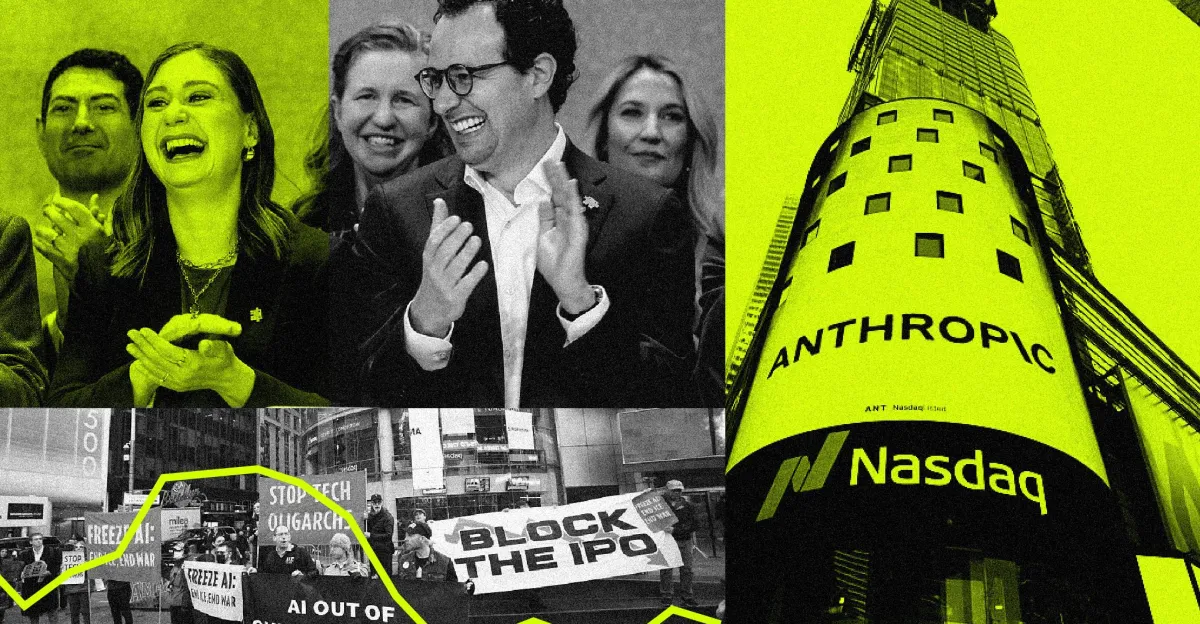
Today, I’m talking with Hayden Field, The Verge’s senior AI reporter, about the Anthropic IPO for the third and final episode in our series about AI in real life.
The AI lab behind Claude went public on the Nasdaq last Thursday. The numbers are gigantic, but not really that important for this conversation, except to say that Anthropic has become one of the most valuable companies on the planet.
The real story is what happens now — and whether Anthropic can continue to thread the needle of caring about and investing in AI safety while also being a public company beholden to shareholders. Oh, and it also continuously growing the amount of money it makes so it can keep paying its ever-increasing compute bills, which total roughly $900 billion over the coming years.
All of these ideas sit in a fascinating tension with one another, and so Hayden and I really tried to break down how we think this might play out as Anthropic navigates the pressures of the public markets.
You’ll hear us talk about the company’s unique corporate governance structure, something that is especially relevant in the wake of the ongoing Jensen Huang saga. We also get into why OpenAI seems happy to have let Anthropic go public first, and why Anthropic’s whole pitch to big customers boils down to the same safety branding that now sits in conflict with the profit-oriented part of its business.
Before we get going, do me a favor and subscribe to Decoder on YouTube, where we put out new episodes every Monday and Thursday.
Okay: Hayden Field, The Verge’s senior AI reporter, on the Anthropic IPO and the economics of frontier AI. Here we go.
This interview has been lightly edited for length and clarity.
Hayden Field, welcome back to Decoder.
Thanks. Great to be here.
I’m excited to talk to you today because it’s not pure soap opera drama chaos.
It’s like a normal thing that happened.
It’s for once not personality-based and soap opera. It’s about cold, hard would-be cash.
[Laughs] Well, there is some personality in it because we’re going to talk a lot about Anthropic’s IPO, which has a bunch of big personalities in it, and the way they have structured this company to repel the rapacious pressures of capitalism is, I would say, very eccentric. It reflects the beliefs of a number of eccentric people.
Yep, absolutely. It’s really been interesting digging into the S-1 again and just seeing who was on what committee and which founders have the most control here and how much control the founders actually have, which is more than it may seem.
Let’s start at the start. You and I are talking on IPO day. Anthropic is the first pure AI lab to go public. They priced the IPO at $83 a share and they got all the way up to $111. By the time people are listening to this, who knows what the price will actually be, but it’s been a real victory lap for all the people who are invested in Anthropic. A bunch of law firms have changed their homepages to be like, “Congratulations, guys!”
What do you make of this? Is it just the thing that had to happen or is it a sign that the AI bubble is not going to pop? How should people think about it?
I don’t think it really gives us new information about whether the AI bubble is going to pop or not, because I mean, this is peak AI hype right here. It’s the first AI lab to go public. It’s been kind of on track to break records for months. Everyone was like, “It’s probably going to beat Musk,” and then it did. I can’t wait to see his tweets later.
But the other interesting part of this is that I’ve heard thousands of new millionaires and hundreds of new centimillionaires will be born from this, not to mention billionaires, too. It’s one of those things where I think the AI bubble is continuing to swell.
I was even chatting with some tech workers inside a bunch of different companies this morning, and they were all saying within their companies, they’re seeing the bubble swell and swell, and they’re being tasked with doing more and more AI, even if it makes them less productive and makes the work less good.
So I think there’s going to be a reckoning eventually, but right now we’re at peak AI hype and Anthropic does a great job of marketing its business as safe AI. Of course, they’re going to have more pressure around that marketing term now more than ever. So it’s going to be interesting to see the tension point kind of go into the spotlight and see how they handle this.

Verge subscribers, don’t forget you get exclusive access to ad-free Decoder wherever you get your podcasts. Head here. Not a subscriber? You can sign up here.
I was at the Semafor conference earlier this week. I saw Sam Altman and Sarah Friar, OpenAI’s CFO, on stage there. Altman and Greg Brockman were at the DealBook conference this week. I get the sense they’re kind of happy that Anthropic went first to see what happens in the markets and to see how companies value the revenue potential of their big competitors so they can tell their IPO story better.
Is that the sense you get, that Anthropic is the trial balloon? Or is OpenAI just retconning the fact that it didn’t go first?
Yes, I think that’s absolutely the case. I heard there was a time in the past year that Altman was really obsessed with beating Anthropic to go public. That’s what I heard. It was all he thought about. But then with all the bad press around OpenAI this year, they’ve had setback after setback. A lot of the public is particularly focused on hating OpenAI right now.
Obviously, there’s a big AI populism backlash and a lot of people hate a lot of AI, but it seems like OpenAI has really borne the brunt of a lot of public hatred and scandals this year. And so they were like, “You know what? Let’s just take a step back and let Anthropic go first.” And they seem happy to do that.
Now that Anthropic has gone first and set this historic precedent, OpenAI can ride on its coattails and say, “Yeah, us too.” I doubt they would beat Anthropic’s record. Maybe they will, maybe they won’t. But either way, I think they know that things could have gone a lot worse for them if Anthropic did not go first, if it’s happening this year.
I can’t stop thinking about Anthropic in terms of just dumb business fundamentals now that it’s a public company. You buy a token from them. They have to make that token for less than you pay for it. They also want to make AGI. Somewhere else they have some other huge set of costs.
Just based on what we know about the business today, now that it’s a public company, are they profitable on the face of it? Do they have a long way to go before inference is so profitable it can pay for training all the new models? How does their business actually work?
They have a long way to go and that is why it’s going to be so interesting to see what exactly they do here with regard to driving more revenue, which is what they’re going to have to do. I saw one estimate from Steve Rattner saying Anthropic is going to have to increase its revenue roughly 17-fold within the next 10 years to deliver a comparable return to some of its competitors in the tech industry.
But even without that specific number, you can tell. I mean, when a company goes public, investors want to see a return on their investment. They want to see profits go up or just profits at all. They also want to see that even if profits aren’t a thing yet, they want to see that you’re driving so much revenue that they could see profit happening in the near term. That is something that Anthropic is going to have to reckon with more than ever before after today.
I was chatting with a bunch of corporate governance experts and law professors and they were all saying Anthropic, like OpenAI, has such an unusual corporate structure that they aren’t actually beholden to shareholders in the way that some public companies are. Shareholders can never vote out executives. They don’t have a lot of power to influence anything really. It’s the founders and this special trust, which we can get to in a second, that have the power.
But either way, they were all saying it doesn’t matter if shareholders have a say here really in voting. It’s about the fact that no matter who has a say, Anthropic is going to be under so much pressure to make money and to buy compute and catch up with OpenAI in that way, that this is going to be a huge reckoning for them. We’re probably going to see a lot of things fall by the wayside, maybe even some expensive safety efforts.
I want to come to the governance structure angle here. We live in a time of Nvidia scandals. Corporate governance is all the rage now. It’s the hottest topic in American business, but let’s come to that in one minute.
I just want to stay on “can you sell a token for a dollar more than it cost you to make it” for one more turn. It’s just the dumbest way of thinking about this. Anthropic rents capacity from big cloud providers, from hyperscalers. They run the GPUs in them. They pay for power, they pay for the GPUs. There’s some input cost and then they have to sell the token for more than all those input costs.
That is the dumbest way of thinking about their business. I promise you that they think about it in a more sophisticated way than that, but that is how I think about it. I was just at the Microsoft Ignite conference this week and I saw Satya Nadella and he was very clear to me and others that they’re going to try to bring the price of tokens down, that their whole system is designed to make all the AI vendors fungible underneath Copilot and they’ll pick the best model for the task and make sure you get the cheapest one for whatever it is you’re trying to do.
That seems totally at odds with what Anthropic needs to do, which is get more and more margin for every single token they sell so they can keep renting capacity from data centers or buy more chips than OpenAI or whatever it is they need to do. How are they structured to solve that problem? Is it just more people using AI or is it more expensive tokens?
I think it’s a little of both, and it’s interesting because Anthropic has been kind of sneakily trying to do this. We wrote a piece in the past year about how there was a big outcry, particularly focused on Anthropic, for passing on costs to consumers. Individuals who were customers of Anthropic were really mad because they felt like the prices were going up for the same stuff or for worse quality and that costs were just getting passed on to them.
This became a thing across the industry, a big outcry, but Anthropic bore the brunt of it. Anthropic had to have a public statement. They’re like, “Look, we’re going to work on this.” And they did roll it back a little, but I mean, they’ve got to keep doing it in some way.
The other thing they’re focused on is hoping that their models are going to be good enough that people just form an attachment — not emotionally, well maybe — but form an attachment to them and they can moat people in. They’re all about the moat these days: “We’ve got to build a moat.” OpenAI is about this, too. They want so much of your everyday life and business to be married to Anthropic’s tools that it’d be really hard to port it all over and you won’t want to and you’ll just keep paying. So that’s what they’re going for.
They’re also, of course, hoping that enterprise and government contracts are going to really make up a bunch of this, in which case you don’t have to worry quite as much about nickel-and-diming because they’ve got a lot of money. But I think that’s the interesting part here. When it comes to people that do care about the price a lot, they’re just trying to moat them in and hope for the best.
What’s interesting there is that consumers are sensitive to price in one way. I think Anthropic’s big business customers, which is where they’ve been historically focused, are sensitive to price in different ways.
If you’re paying Anthropic a lot of money, you might want to be able to switch providers quickly and you might demand data sovereignty and all this stuff that big enterprises are thinking about. Anthropic either has to deliver that, which would kill their moat for their big enterprise customers, or say, “We’re so good, you can’t have that.” I’m not sure that they can say the second one yet.
That’s why they’re marketing this safe, trustworthy AI line so deeply, because it’s the only thing they’ve really got going for them here. When you have an enterprise customer, most of the time you do have to give them data sovereignty. You can’t trade on their data. There’s a lot of stuff that Anthropic could be doing to make more money that they can’t do when someone is paying that much.
I think that’s really why they’re driving home this point of being the safe, trustworthy alternative because that’s the only thing that’s really going to get people to stick around, particularly if they also drive home the cybersecurity tools in an age when everything’s getting hacked all the time.
The other interesting thing is even not with huge enterprises, but with small to medium-sized businesses, I’ve been chatting with a bunch of them and they’ve all been creating their own internal tools to kind of track which tasks they need specifically to use an expensive Anthropic model for and which ones they can port over to maybe an open-source model or a really cheap model.
So a lot of companies like law firms — and people in a lot of different industries that have small to medium-sized businesses — are literally creating their own internal benchmarks about, “Okay, let’s save money as much as we can to just only put 10 percent of our tasks toward the expensive Anthropic model, and then this 40 percent can go to an open-source model and this 50 percent can go to a mid-tier, cheaper model.”
So that’s what’s really interesting to me. People are trying to figure this out on their own and not even sharing those benchmarks publicly because it’s their own way of budgeting.
I actually heard Nadella this week say every company will have its own set of evaluations and they will test the models against them and always use the most efficient one and this will become one of the major things that every company does.
The flip side to that is I’ve heard Anthropic executives say, “Well, you will always want the frontier model because your competitor will always be using the frontier model and if you use a cheaper one, you’ll be left behind.” And that has always seemed somewhere between naive and idealistic to me because I think a lot of companies do cheap things knowing that their competitors will also do cheap things.
I agree completely. Everyone’s being cheap.
Yeah, I think if you can get away with good enough, you’re going to find out exactly where good enough is and you will not assume that your competitor is going to eke out a 5 percent advantage by using a more expensive model. Somewhere on the margin is where all of the costs should be and the market will figure it out.
It just feels like the basics of the business, maybe on IPO day, the pressure isn’t on that, everyone’s just very happy and rich. The next quarter’s earnings are going to be where we start to see this shakeout. Can it keep growing the way it’s growing at the margins it needs to build everything, especially when its own suppliers are now major shareholders?
Totally. And we saw one quarter where they experienced huge growth and then the next quarter wasn’t that much. So yeah, I mean they’re going to have a lot to reckon with.
Let’s talk about the governance issues. Because of Nvidia, corporate governance is the hottest topic in American business. Like you said, OpenAI and Anthropic have some of the most complicated governance structures in history.
If you think that Anthropic’s future is to sell the best intelligence — the most capable, the most cutting-edge frontier, close-to-AGI intelligence possible — you would probably not do a bunch of safety work. You would probably not kill your margins on a bunch of researchers who are telling you to stop or slow down or not release the best model.
Anthropic is deeply committed to doing that. You and I have had conversations before about whether that can withstand the pressures of capitalism and growth. That was hard when they weren’t a public company, but now they are. Talk about Anthropic’s structure and how they’re trying to codify their commitment to safety.
Yeah, that’s a really great question. I just published a piece about this. It’s so interesting to me that Anthropic, despite seeing all the roller-coaster drama that OpenAI went through around the Sam Altman ouster and all of the restructurings that that company has gone through, Anthropic has a similarly unusual structure. And in a way it’s helpful because they’re not beholden, as we said, to shareholder pressure besides if shareholders start selling off their stock or don’t buy more.
But the two kinds of groups of people that have power over what happens at Anthropic are the founders and this group called the Long-Term Benefit Trust (LTBT). Anthropic likes to market this as being like, “Oh, don’t worry about that the founders are doing what’s best for humanity but with no checks. We’ve got this trust above us that can appoint or remove us anytime.” As we’ll see in the movie Artificial, Sam Altman famously says, “Oh, well, the board can fire me whenever.” He says that a million times.
Now, Anthropic is implying the same thing: “Oh, we have this trust above us. They can remove or appoint the majority of board members,” even though it’s actually not all of them, but we’ll get to that in a minute. So this trust is a group of right now four people and none of them have a lot of AI experience. It’s [former Federal Reserve Chairman] Ben Bernanke, a foreign policy analyst named Richard Fontaine, an experimental physicist named Christopher Stubbs, and a former GiveWell executive named Neil Buddy Shah, who is chair of the LTBT.
I spoke to a couple of former Anthropic employees that left not too long ago and one of them said that this trust is kind of handpicked to not rock the boat at Anthropic. The founders appointed them. They’re not going to be appointing someone that’s going to probably disagree with them a lot.
Ironically, the trust doesn’t have the authority to step in on everyday decisions at Anthropic, unlike even the OpenAI nonprofit board that existed. They could say, “Oh look, don’t release this model. It’s too dangerous.” The trust doesn’t have any of those powers. All it can do is appoint or remove certain board members. Even then, they have to give 30 days’ notice to a small committee of the board, which includes Daniela Amodei, the chair of that little committee who is also a founder of Anthropic.
To oversimplify things, out of these seven board seats, the trust gets to pick three, the founders get to pick three, and then the kind of tie-breaking seat, the seventh one, the trust technically appoints, but they have to basically get founder approval to do it. So it’s one of these things that’s so complex, but when you really look at the nitty-gritty of it, the founders have pretty unchecked control here. I think that’s something that’s getting lost in the narrative of, “Oh, this trust is above us. Don’t worry.” Okay, well, they don’t really have much power to check you.
The founder control structure is the wildest thing I have ever read about in years of doing the show and thinking about business. Anthropic has seven founders. They have been issued a single share of stock that holds 50.1 percent of the voting power of the company. That is issued to a company called Founder LLC, and they’re the seven co-owners of Founder LLC.
How on earth does that work? Do they just all get together and then decide how to vote the one share of stock?
Yeah, it’s really interesting and that’s why I was kind of oversimplifying it a minute ago with who gets to choose this tie-breaking seat because it’s technically Founder LLC. It’s just a total mess. But when you really look at the simplified version, it’s that yes, through all of these weird structures and things they’ve done, they basically have pretty unchecked power and that’s the way they want it.
When I was talking to a former employee who recently left, they said it’s not necessarily that the founders have a financial interest in making the most money. In their eyes, it’s more that they have an interest in unchecked control. I think that’s a really important point here.
Some dissenters within the ranks of Anthropic think it’s not about them wanting to get rich, but rather it’s about them wanting that total control, which does track with a lot of their public statements. They say, “You can’t do safety from second place.” They’re all in on speeding up this race, but the problem is when you speed up the AI race, you’re speeding it up for everyone involved.
The safety piece is the really interesting portion of this to me because it’s the thing you would spend money on, absent some huge litigation drama or liability concern, that no other company would spend money on.
So let’s say it’s proven in court that model companies are liable for what people’s agents do. I think then all the model companies would build safety systems. They would have some big incentive to make sure their models are safe. That has not yet happened. We don’t know. There’s a big debate about safety and where the regulation will come from and what will create the incentives.
In the meantime, you’ve got seven founders holding a single share of stock who right now appear to be aligned on investing in safety in various ways inside of Anthropic. What happens if they start to disagree?
Yeah, that’s a great question. I think that the other interesting question here is what happens when you can explain away anything in the name of safety if you’re thinking it’s “for the greater good,” which as we know is a common villain trope in every movie. But it’s also one of Anthropic’s main things on its website. They’re like, “We want to do this for the greater good, for the global good.”
If you’re saying, “Hey, we have to win this race at all costs because we’re the only good guys and anyone else who wins it is going to do worse than us,” are you really the good guy at that point? And can’t you just explain away any single decision, even dropping some safety measures, as saying, “Oh, it’s slowing us down too much. We’re going to lose. We’ve got to win at all costs”? So you drop this or drop that. And then you look in the mirror at the end of the race and you say, “Oh, actually, we’re the exact same as the other company we’re trying to be different from.” I think that’s increasingly happening.
So I mean, right now they’ve said, “Look, we’re really committed to this.” You do have to remember that these people are almost religiously dedicated to this idea of safe AI. A lot of them think that AI systems are potentially conscious. I mean, this is by Anthropic founders’ own statements.
So I think that it’s not like they’re just secretly only trying to make money and just talking about safety and they don’t mean it. I think it’s more something a little more dangerous in that they want complete control because they believe that they have the right plan for AI safety and they will do it better than anyone else.
But as we know, absolute power corrupts absolutely. So a lot of Anthropic employees that I was talking to, former ones, were saying, “Yeah, it does not make sense that this industry is so unregulated. There’s no external regulation. Even if these seven people think they have the best idea for AI safety, okay, then prove it to someone else — that you shouldn’t be the only ones deciding this. Because you’re not elected.” So that’s the consensus among some.
They have a morally binding handshake agreement to allow external auditors, Hayden. It’s going to be fine.
Oh, yeah, with employee-level access.
Also, it’s called “Super Intelligence” now. It’s going to be totally fine. They all went to the White House and they looked deeply into each other’s eyes and said it was going to be fine.
Obviously Anthropic came up with this structure well before the events with Nvidia and Jensen Huang, but I can’t help but put them together in my head. They are happening at the same time. And Nvidia has a very traditional corporate governance structure.
Jensen owned 3 percent of the company, but he had a board of directors. The board of directors determined that he had violated the company’s code of conduct in some way. He resigned. It’s very obvious that he was thoroughly encouraged to resign, but that’s just normal corporate governance. That’s what you learn about in school. A company has a board of directors. Their number one job is to hire and fire the CEO.
That’s very different in Silicon Valley, right? Founder control of companies is a big story everywhere. Mark Zuckerberg famously has control over Meta, even though Meta shareholders repeatedly vote to remove him, which is one of the underemphasized stories in all of American business. Sergey Brin and Larry Page control Google.
Is this more in the, “We need to insulate our founders from the demands of the market and boards of directors” in classic Silicon Valley style? Or is it, “We need to insulate our founders and Dario from the demands of the market so we can stay focused on AGI and safety”? Because it feels like a combination of both.
It’s definitely a combination. I mean, they say it’s the latter. I think in a lot of ways it’s like the former. It’s totally a combination. I’d say it’s about 50/50. I mean, they want control so that they can focus on what they think is best and not lose control to someone that they don’t think knows best. But ironically, as we know, no one group of people should be in control of what is best here. So at least that’s what a lot of my sources say.
So I think that, yeah, I mean, it’s just a combination. Elon Musk famously won’t run a company that he doesn’t have voting control over. So I think it’s just a new Valley thing and it’s pervading here for a couple of different reasons.
There are seven of them. What seven different people do over the course of the next five to 10 years is as unpredictable as anything. What happens if one of them does something illegal or lies to the board or smuggles chips to China or anything? Is there some way to remove one of these founders from this LLC?
Yeah. I mean, allegedly the trust has the power to remove. They haven’t said whether they have the power to remove all of the board or just some, but in some way when you’re looking at the fine print of the S-1, basically if the trust gives 30 days’ notice to essentially Daniela Amodei and her other two people on this subcommittee, then they can suggest removal of a board member. Again, they can waive that 30-day notice if they deem it correct, if Daniela does.
But yeah, there’s a lot of fine print here. Essentially, yes, you can remove someone and there is stuff about that in the S-1 saying if they’ve done something illegal, if they’ve done something really bad, they can be removed, but it’s definitely not easy. It also depends on who it is, I think.
It’s interesting. I keep coming back to this because it is so complicated, it’s so unusual, and it is right next to the Nvidia situation where he materially misrepresented his relationship to the shareholders by having his PR people issue statements saying it was all normal. He had to admit that it wasn’t all normal and he was in fact involved in extramarital affairs and the board fired him.
I felt a little bad for that PR guy who had to put his name on all those statements that ended up being a lie.
I feel nothing. As the audience may know, as Hayden is well aware, we make all the PR people put their names on everything just in case something like this happens. That’s just a little bit of Verge trivia.
Anyhow, right, I mean, that’s just normal governance. Here you have a company where the only check might be the market itself, right?
If they can’t sell tokens for more than what they make them for, they’re going to have to report that in the financials and the market might say this company is failing and pull all the money back. That is a very different kind of pressure.
If the only meaningful way that Dario might lose his job is if the company goes bankrupt and then the swirl of things is he’s got to buy chips before OpenAI can buy the chips, he’s got to increase the number of verticals that Anthropic competes in within the enterprise, and he also idealistically has to train the next model and the next model with RSI to get to AGI, it feels like actually the pressure is to go as fast as possible. If I just added that up, I would say I would not slow down ever.
Yeah. That’s why I say you can kind of explain away anything if you’re trying to be first, which they are. And they’ve been very public about that. Regarding the money thing, Ann Lipton, a law professor at the University of Colorado Law School, told me this week that the trust and the founders together are the ones who actually have governance power and that you either trust that they’re going to balance the interest of society appropriately or you don’t.
But either way, the real constraint on whatever impulses they have is going to be the fact that Anthropic needs money. That’s the thing, Anthropic needs money. In a livestream recently, Dario told the CEO of JPMorgan Chase that compute is the “deepest business dilemma” that the company faces. Essentially if you buy too much, you can financially overextend yourself. If you buy too little, then you can’t support inference for customers.
Even more importantly, you can’t do the R&D. You can’t come up with new models. So they’re extremely compute-constrained, even maybe more so than OpenAI because OpenAI was made fun of for a long time for losing a ton of money, but they were investing a lot in compute. Anthropic did not do that as much, and now they’re having to pay the piper.
So it’s an interesting turnaround here. Hopefully for them and their interests, I guess, if they can get the compute they need. But as we know, the supply is a lot lower than the demand. So it’s just going to be interesting to see what they will do to make money and therefore money to buy compute.
It’s funny. A couple of weeks ago I told our colleague, Liz Lopatto, that the Anthropic IPO would be one of the biggest stories of the year. She was laughing at me today, because she says it’s not even the biggest story of the week because of Jensen Huang and Nvidia.
My argument — take it or leave it, and you can judge whether I’m correct — is that they are the same story. That if Nvidia’s financing architecture fails or wobbles because Jensen isn’t there to bully everyone into believing in it, then maybe you do have a glut of chips sitting in data centers without the appropriate permitting or power to light them up and the market for chips will change dramatically.
Maybe a company like CoreWeave does get way more wobbly or some of the already wobbly neoclouds start to get wobbly and the price of compute falls and lets Anthropic compete differently. Maybe a bunch of chips that were allocated to China on the gray market come flooding back to the United States.
That apparently will happen.
Right? So there’s a lot of ways the Nvidia story affects Anthropic’s financials. Has the company said anything about that yet? Is the market reacting to that in any way?
Not yet. They’ve just talked about how important compute is and that it’s going to be a really big issue for them. And Anthropic’s IPO, it has a lot of ties to Nvidia and there’s a lot of complexities here because Nvidia had agreed to buy $10 billion in Anthropic shares via private placement on top of a $10 billion funding promise it made last year.
So they are in bed together, and that’s going to be interesting to see, too. The new CEO of Nvidia has made a lot of claims about diverting chips that were potentially going to China and bringing them back so they’re not doing that anymore.
Now we’re going to see if there’s more supply or not. Also, Jensen personally made some of these deals, especially with large financial institutions to fund the AI infrastructure buildout last August. So he’s wheeling and dealing a lot. And so it’s going to remain to be seen whether the new chief executive has that kind of power to wheel and deal and pressure people into doing stuff like this or not.
This is my last question. Obviously everyone’s just celebrating today. We are probably throwing the most cold water on this by noting that the structure of Anthropic is very odd. What should people be looking for? What are the signs that you’re looking for now that Anthropic is a stock that’s trading? What’s the relationship in your mind between the value of Anthropic stock on any given day and the broader AI story?
I think that stock is a little bit like benchmarks in the AI industry in that sometimes it doesn’t mean what you think it means and also it never means everything. So you always take it with a grain of salt. It’s all vibes based. It’s all hype. So people get scared, they sell, and people hear one good thing or a rumor and they buy. So I think it’s important to look at it and see what’s driving that fear or hype that day or that week. But it’s also really important to see what the company says in these reports and earnings calls.
That’s what I think is the most interesting. Not really the numbers all the time, but instead, what they try to sneak into these reports by saying, “Oh, we sidelined this team,” or, “We discontinued this safety initiative all in the name of being first.”
That’s the type of thing that I think we’re going to see a lot of and that’s what I want to watch for. Because the company that made its bed on safe AI is increasingly looking the same as OpenAI and is going to have a lot of swept-under-the-rug type of updates like that, if my sources are right.
You heard it here first. Former CNBC reporter Hayden Field says, look past the day-to-day swings into the fundamentals of the company. That’s good. Also, the stock market is only vibes. That’s the other thing I heard you say.
Yep. I mean, it’s controversial, but after being a financial reporter, yeah, I mean, there’s a lot of vibes there. It’s a lot of vibes.
Oh, I agree. I think sometimes the only thing they ask me to go on CNBC to say is this is just vibes, and then they usher me off the air very quickly.
Hayden, this is great. We’re obviously going to be talking about this story many times with you in the year to come. Hopefully we can do another straightforward business story and not just a soap opera one.
I’ll be here for both. We’ve got to do them both.
Amazing. Thank you so much, Hayden.
Questions or comments? Hit us up at decoder@theverge.com. We really do read every email!
Decoder with Nilay Patel
A podcast from The Verge about big ideas and other problems.