



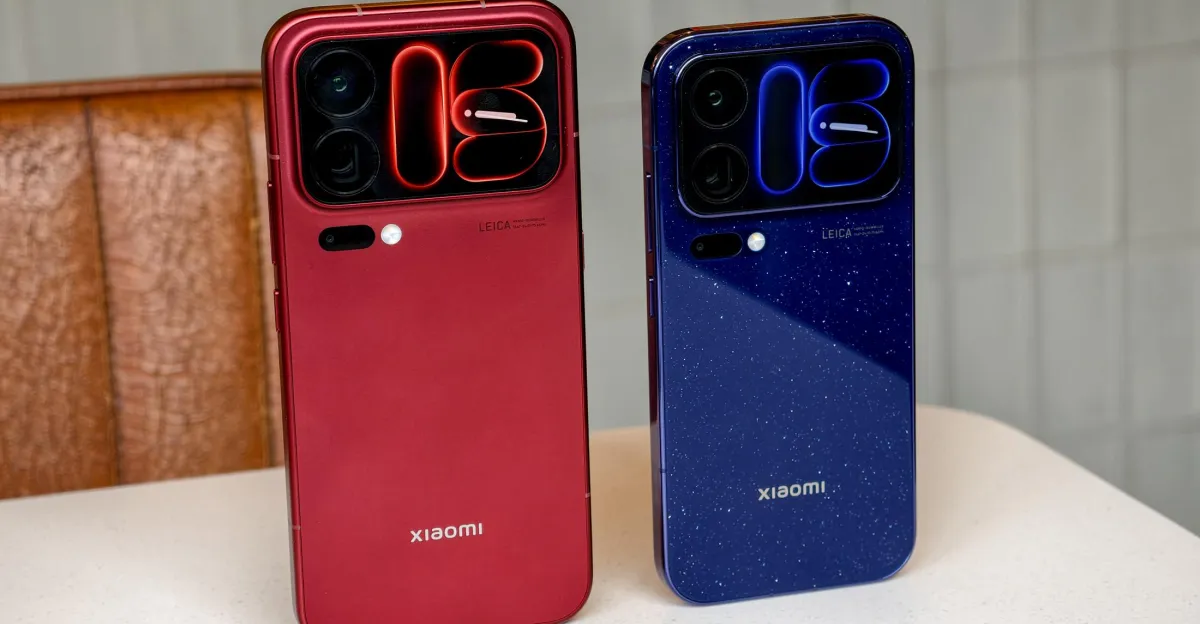
Xiaomi introduced a second screen to its flagship phones with last year’s 17 Pros, but didn’t release them outside China. That means the new 18 Pro and Pro Max are the first chance I’ve had to find out if a screen on the back of a phone is any more useful now than it was when Xiaomi last tried it on 2021’s Mi 11 Ultra — not to mention earlier efforts by the likes of Nubia and Vivo.
After a week or two with both of Xiaomi’s new Pro phones, I’m not entirely sold. The rear display has a single, obvious use case — it’s helped me take some of the best selfies I’ve ever managed — but it isn’t very useful otherwise.
The rest of the phones are great, with good cameras, big batteries, and a more flexible take on the privacy display seen in the Samsung Galaxy S26 Ultra. There’s a lot to like. But with prices higher than ever thanks to the RAM crisis, it’s hard not to wonder how much buyers are paying for a second screen they could probably do without.


$1570
The Good
- Excellent main and telephoto cameras
- Privacy display
- Strong performance
- Compact
The Bad
- Rear display is limited
- Basic ultrawide camera
- Expensive


$1830
The Good
- Excellent main and telephoto cameras
- Privacy display
- Strong performance
- Extended dynamic range
The Bad
- Rear display is limited
- Basic ultrawide camera
- Expensive
There are two Xiaomi 18 Pro phones: the £1,199 Pro (around $1,570) and the £1,399 Pro Max (around $1,830). In the UK and Europe, they’re priced to compete directly with the iPhone 18 Pro and Pro Max.
They come in similar sizes to the iPhones, too: a 6.4-inch display on the Pro, and 6.9 inches on the Pro Max. There are a few other differences, though not many. The Pro Max’s 7,050mAh battery is bigger than the Pro’s 6,000mAh (with larger batteries available outside Europe), and its 100W wired charging is 10W faster too. Both phones last a day pretty comfortably and will stretch to two with lighter use, though only just — I’ve seen better battery life from recent Oppo and Vivo flagships. They also use Qualcomm’s Snapdragon 8 Elite Gen 6 chips, though only the Pro Max has the Extreme version. And while the camera setups are nearly identical, you’ll get slightly better dynamic range from the bigger phone thanks to a LOFIC sensor.

The rear screens also vary slightly in size between the phones, though at either 2.7 or 2.9 inches, there’s not much in it. Wrapping around the two main rear camera lenses, they look a lot like the displays you’ll find on the front of foldables like the Galaxy Z Flip 8, though smaller than most of those, and much more limited in functionality.
You can set your choice of wallpapers, some of which are interactive. Listen to music or a podcast, and playback controls appear. You can turn on notifications, useful for when you want to rest your phone face down, but Xiaomi’s implementation is odd: App icons appear so large on the screen that there’s no space to fit much text from a given notification; there are no interactive responses like quick replies or marking emails as read; and you can’t see a list of your notifications, only viewing each for a few seconds as it comes in. It makes this just barely more useful than a notification LED.


Unlike flip phones, you can’t use the small screen to access the phone’s settings, and you certainly can’t run full-blown apps. Instead, there’s a natural-language AI tool to create your own apps, powered by Google’s Gemini 4 Argon. It’s good for simple tools or games — I made a pomodoro timer and a semi-functional knockoff Pac-Man — but your creations can’t connect to the internet or access other apps, so anything you make will be quite purposefully limited.
The only thing that’s convinced me the rear screen is at all worthwhile is its camera viewfinder. The UI’s a little fiddly at this scale, but you can take photos, record videos, or create a photo booth-inspired picture set, all using the rear main camera. I’ve taken the best selfies of my life with this phone, which may be reason enough for some people to buy it.
1/21
It helps that the main camera is especially good. It and the telephoto are both excellent 200-megapixel shooters with large sensors, capable of great results in almost any lighting conditions. The telephoto’s short minimum focusing distance of 12cm lets it double as a great macro camera too. The 18 Pro Max has a slight photographic advantage, with a LOFIC main sensor that offers an expanded 16-stop dynamic range, helping it capture better highlights in particularly tricky lighting. Most of the time you won’t see a huge difference between the two phones.
Xiaomi’s longtime camera partner Leica is involved again, and by default you can shoot in one of two Leica-branded camera modes — Vibrant or Authentic — plus a new third option, the Xiaomi-branded Original, which splits the difference between them. The other big Leica contribution is a new Essential Moments mode that uses AI to simulate three different retro Leica aesthetics in either 35mm or 75mm lenses.
1/9
The ultrawide, set apart from the other two lenses beneath the screen, looks like an afterthought — and it shoots like one too. It’s placed so low on the body that my finger frequently blocks its view; its 17mm focal length barely feels wider than the 23mm main camera, so it doesn’t give you much extra room to play with; and its smaller sensor means quality is noticeably worse than from either of the other rear cameras, especially in dimmer light. As for the selfie camera, it’s decent, but you’ll only ever use it for video calls since the rear screen makes the main camera the better choice the rest of the time.

The Xiaomi 18 Pro phones have one other trick: a privacy display. This is a pretty direct imitation of Samsung’s Galaxy S26 Ultra tech, switching between different sets of pixels with varying viewing angles to make your screen hard to see from the side when it’s activated. Like Samsung’s version, you can turn it on across the phone or just for certain apps; unlike Samsung’s, when you activate it for specific apps, it also applies to specific notifications, and it works with split-screen or floating windows without affecting other apps open at the same time. It’s more flexible than Samsung’s version, though to my eye, less effective.

The Xiaomi 18 Pro and Pro Max have plenty of strengths, with great main and telephoto cameras, good performance, and reasonably attractive designs. But shortcomings like the lackluster ultrawide camera and batteries that don’t last as long as some rival flagships make me wonder about the compromises made to fit that rear display. Its limited functionality has given me pause, especially as flagship phones like this hit increasingly eye-watering prices.
Photography by Dominic Preston / The Verge