



Power banks are useful but boring. Trust me, after testing more than 100 power banks, I’m qualified to bemoan the lack of innovation. These rectangular battery packs are mostly utilitarian. You get big laptop power banks and slim phone power banks, but fresh designs are rare, so Nimble’s SharePower immediately brought a smile to my lips.
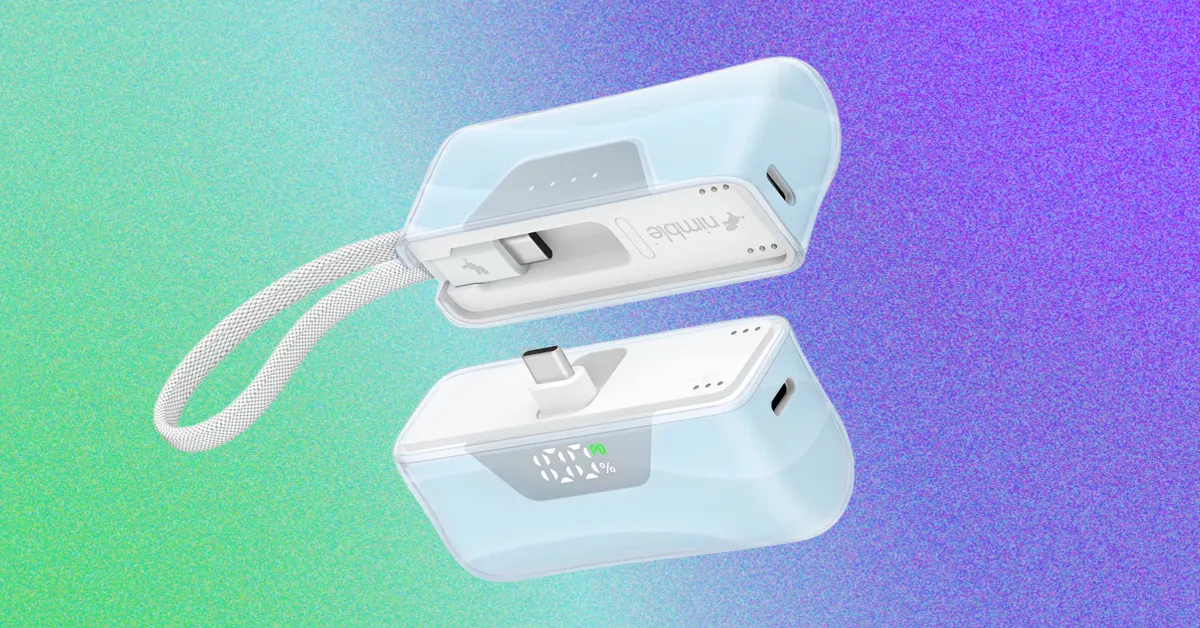
The Nimble SharePower is a 10,000-mAh, modular power bank that you can snap in half to give you two separate and fully functional 5,000-mAh chargers. They connect magnetically with tiny pogo pins, and each half has its own built-in USB-C (one cable that doubles as a carry loop and one fold-out connector). The idea is that when friends or family are running low, you can break off a half and share the power.
Sharing Is Caring
This thoughtful design works beautifully, and within seconds of unboxing it, I found myself pulling the power banks apart and snapping them back together again, because the magnetic mechanism is super satisfying. When it’s together, you have a compact, 10,000-mAh power bank that can put out up to 35 watts to charge up to three devices at once, with a built-in cable and two USB-C out ports. A digital display shows you the exact remaining percentage.
It’s a roughly 3-inch square about an inch thick when together. Break it apart, and each 5,000-mAh module works independently to provide 20 watts. The top half has the USB-C cable loop, a USB-C out port, and four LEDs to show remaining power. The bottom half has that pop-up USB-C connector, a USB-C out port, and the digital display showing remaining power as a percentage.
What’s really cool about Nimble’s SharePower is that it balances the load. So, if you break off half and a friend uses it to charge their phone, when you put it back together, the other half will share the power. Instead of one half being fully charged, it splits equally. This was a technical challenge, Nimble cofounder and CEO Ross Howe told WIRED, and the company spoke to the chipset provider for some big folding phones (with split batteries inside) to work out the load balancing to ensure it didn’t keep seesawing until it ran out of juice.

Photograph: Simon Hill