



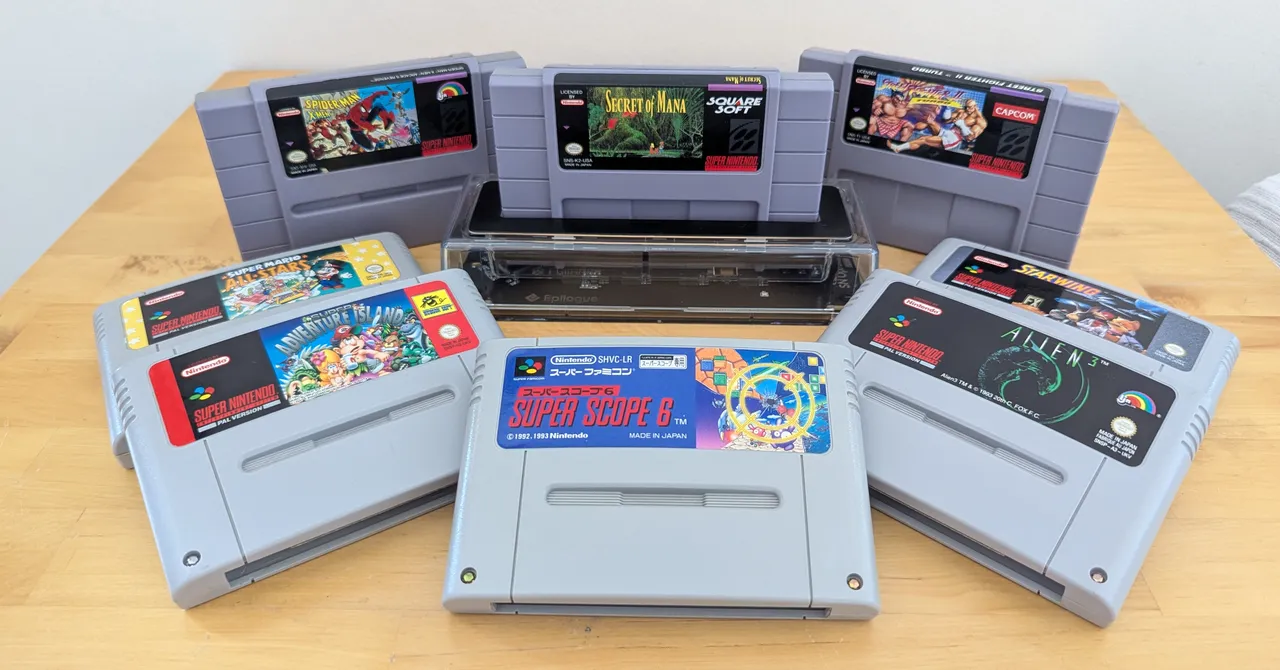
There were workarounds—European or Australian gamers will likely remember dual-boot adapters that used a local cart to ‘spoof’ the console into accepting an imported American game—but with different TV standards to consider, most players were effectively limited to only the games released in their home territory.
With the SN Operator, that’s all literally consigned to the past. All cart sizes fit, and lockout chips are ignored—insert a game from anywhere in the world and, so long as it’s still in good working order, it’ll load. Modern displays mean old hurdles like different NTSC or PAL display standards are irrelevant.
That brings a few material benefits for purists. When the NTSC versus PAL distinction was an issue, it often meant PAL games ran more slowly due to the standard’s lower 50-Hz refresh rate compared to NTSC’s 60 Hz. Being in the UK, I can finally play Street Fighter II Turbo at its original speed, or the classic action platformer Spider-Man and the X-Men in Arcade’s Revenge without Spidey feeling like he’s web-swinging through mud. Region-free also benefits North American players, allowing previously incompatible exclusives from other countries to be imported without worry—great for cult curiosities like Konami’s Pop’n Twinbee games, only released in Japan and Europe.
The Playback software even identifies which region’s version of the game it is—accurately clocking my UK copy of Star Wing (Nintendo couldn’t use the Star Fox name at the time). Counterfeit carts are detected, too. Speaking of Star Fox/Wing, there’s a host of options to tweak how the SN Operator handles Mode 7, the SNES’ pseudo-3D visual trickery. Throwing in super-sampling and upscaling features can give 30+-year-old games quite a glow-up.
Another great touch is how it accounts for classic accessories like the SNES Mouse, supporting titles like Mario Paint or Populous II—a strategy game and another PAL exclusive—with your regular, modern, non-SNES mouse. That same mouse can stand in for the Super Scope, Nintendo’s bulky light-gun peripheral designed for obsolete CRT screens. The only downside is that the precision afforded by a high dots-per-inch (dpi) mouse cursor makes those games incredibly easy, as I discovered with a Japanese copy of Super Scope 6, a six-game showcase for the tool. (Incidentally, it’s really only two games, Blastris and LazerBlazer, with three modes each—historically false advertising!) Still, there were only ever 12 Super Scope games released, so it’s great to see even this incredibly niche category of games considered.
By far the best improvement over the GB Operator, though, is an expanded suite of save data tools. Directly saving progress to a cart as you would on a real SNES remains a baked-in feature, and the SN Operator retains the ability to transfer game saves between your computer and cart, but now virtual save states are supported. At any point, you can create snapshot saves of wherever you are in a game—an absolute godsend in playing through Secret of Mana, a sizeable ’90s Japanese role-playing game (JRPG), and one I can now pick up and put down without worrying about in-game save points.