



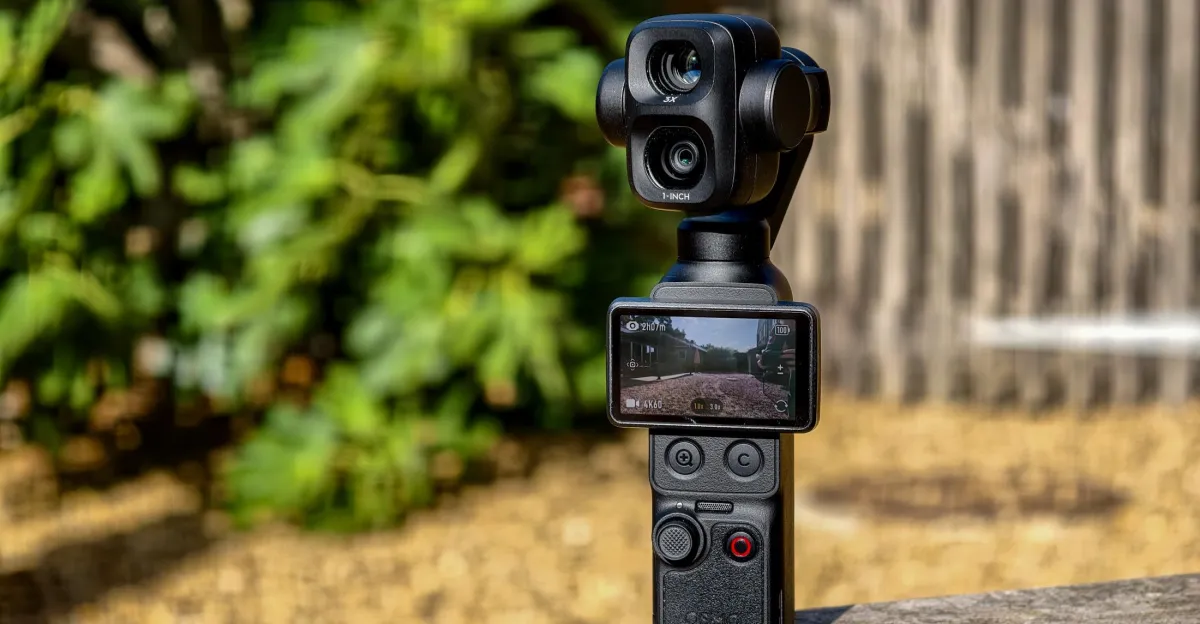
DJI’s Osmo Pocket 4P is a pretty simple proposition: an Osmo Pocket 4 with a second camera lens slapped inside. But is that extra lens worth the added size, weight, and cost relative to the regular Pocket 4? And how does it compare to the only rival on the market, Insta360’s dual-lens Luna Ultra?
It depends on what you’re filming. But I think most prospective buyers would get plenty of use out of the 4P’s 3x telephoto lens, and its quality is certainly impressive. Meanwhile, DJI has managed to undercut Insta360 on price while at least matching it on quality. For most, this will be the better buy, though the Luna Ultra has one major advantage: You can actually buy it in the US.


$680
The Good
- Great quality out of both lenses
- Good zoom up to 6x
- Supports wireless FrameTap remote
The Bad
- Bigger and heavier than the Pocket 4
- Slightly reduced battery life
- Small screen is as fiddly as ever
DJI’s travails in the US continue, and it won’t be releasing the Pocket 4P in the country, despite launches elsewhere. In Europe, it costs £529 / €599 (about $680) for the Standard Combo set, which includes a fill light, carry pouch, and a handle with a tripod thread. For many, it’ll be worth spending extra to get the £605 / €689 ($785) Vlog Combo, which also bundles in a larger carry case, a compact tripod, a DJI Mic Mini 2, and the FrameTap remote.
There had been hope that something remarkably like the Pocket 4P might emerge from Xtra, a company which popped up in the wake of DJI’s ban from the US, selling suspiciously similar products. That now looks unlikely: Xtra has delisted its Muse 2 Pro, halted preorders, and refunded deposits, while the FCC works to crack down on alleged DJI front companies. In short, don’t hold your breath for a US version of the Pocket 4P unless the FCC begins to lose its game of whack-a-mole.
If you are in a country where the Pocket 4P is on sale, what you’re getting really is a sibling to the Pocket 4, which I reviewed in April. It has the exact same body and controls, including an identical flip-out touchscreen, apart from minor cosmetic differences. It has an almost identical main camera, though there are some key differences I’ll get to in a minute. The software, stabilization, recording options, and in-built storage are all either identical, or close enough to count.


Almost every change is a ripple effect from the major new addition: a second lens. This 3x telephoto (or 60mm equivalent) sits above the default camera and is a remarkably close match in specs. It uses a slightly smaller sensor, a 1/1.28-inch-type, rather than 1-inch, but makes up for that with a faster f/1.8 aperture, instead of f/2.0. It supports in the same resolutions (4K landscape or 3K portrait), shoots similar 37-megapixel stills, and can be used in low-light, slow-motion, and timelapse modes. About the only place you can’t use it is panoramas.
The quality of the telephoto is impressive. Details are crisp, helped by the same impressive gimbal stabilization that keeps the main lens steady — I recorded some astonishingly stable footage from a small boat trip on a blustery day in the North Sea. I worried the larger camera might make stabilization trickier, but I needn’t have — if anything, my footage from the 4P feels more stable than from the 4.
The Pocket 4P is capable of recording 4K footage at up to 12x zoom, but beyond 6x you will see the quality begin to drop off. At 12x footage feels a little soft, details lost and text blurry, and I wouldn’t recommend zooming that far unless you really have to.
It’s better up close. The wide f/1.8 aperture creates a relatively tight depth of field with a compressed background, meaning beautiful optical bokeh. That’s ideal for me — this is an excellent camera for shooting products — but also makes it a great camera for portrait video or filming pets.
There’s a slight, short judder in footage when you switch between lenses while recording. Occasionally I’ve noticed a shift in color at the same time, though for the most part, footage from the two cameras looks similar.
The difference is at least in part because the main camera has superior dynamic range, up to 17 stops, along with supporting DJI’s new 10-bit D Log 2 color profile. Those are the chief upgrades that the Pocket 4P’s main camera has over the Pocket 4’s — this is a new sensor, but in the same size and resolution as before, and with the same aperture lens. In most lighting, the upgrades are slight, only coming to the fore in trickier conditions, though the camera still shows some obvious limits when shooting in the dark.
Welcome as the telephoto is, it does come with downsides. Size is the obvious one. At 230g, the Pocket 4P is about 40g heavier than its little sibling. And while the body of each camera is identical, the gimbal and lens apparatus here is about twice the size, making this taller and wider overall. This is still a remarkably compact, lightweight camera, and the extra weight isn’t enough to make it uncomfortable to use. But it does feel just a little less pocketable than before, which might be a limitation if you primarily want this for travel.
The new design makes me a little worried about durability too. When the camera is off, the two lenses now face forwards, rather than sideways into the gimbal arm, meaning they’re completely exposed. That’s made worse since DJI no longer offers a gimbal clamp for the camera, a protective measure I miss. Instead, the lenses are slightly recessed. That offers a little protection from scuffs and scratches, but makes it easier for dust to collect inside. You’ll want to keep a cleaning cloth to hand, and the camera might need more babying than previous generations.

DJI says the Pocket 4P will last for 210 minutes of use, half an hour less than the Pocket 4. That’s still plenty for me though. Charging is the same, with a full charge in 32 minutes, and storage is unchanged too: 107GB built-in, with support for 1TB microSD cards.
The software experience is broadly similar too. There are three buttons and a joystick on the device, with most of the settings accessed by swiping one way or another on the flip-out 2-inch touchscreen. It’s occasionally fiddly given the size, and I still swipe the wrong way more often than I’d care to admit, but it mostly works. The major new addition to the 4P is a new multi-person tracking option, which can detect multiple subjects while following the person in the center.
More exciting is support for DJI’s FrameTap, a small wireless touchscreen that lets you control the Pocket 4P from a distance. The FrameTap was introduced in April with the larger Osmo Mobile 8P gimbal, but this is the first Pocket device to support it. You can start recording, use the joystick to turn the gimbal or zoom in and out, and access a few basic controls along with playback. You can’t access every setting however, and you’re oddly unable to change resolution or frame rate from the FrameTap.


FrameTap support is pretty transparently a response to Insta360’s Luna Ultra, which launched earlier this year with its own dual stabilized cameras in a similar design. The Luna Ultra’s unique feature is letting you pull off the whole front panel to use as a remote; DJI’s FrameTap is a simpler solution to the same problem, with the downside that there’s no way to attach the remote to the camera when it’s not in use.
The two cameras are otherwise remarkably similar in specs. The Insta360 has the advantage of offering 8K recording from the main camera, but the new DJI has better battery life, wider dynamic range, superior slow motion, and double the built-in storage. All that, and it’s £150 / €130 ($150) cheaper in Europe, making this a pretty unequivocal winner. The biggest thing the Luna Ultra has going for it is that it’s actually on sale in the US, for $769.99.

Taken together, the Osmo Pocket 4P is an almost unqualified success. It combines slight improvements to the Pocket 4’s main camera with a whole new telephoto that delivers great performance in its own right, including really attractive bokeh. There are small downsides to portability and battery life, which are good reasons to prefer the Pocket 4 if you don’t expect to make full use of the telephoto here. But otherwise the Pocket 4P is better than both its DJI stablemate and its Insta360 rival, and is undoubtedly the version of this form factor I’m most tempted to buy for myself.
Photography by Dominic Preston / The Verge