



Recently, a man I was rock climbing with told me about how he’d used AI to make a motivational poster for himself, which he’d hung on his bedroom wall: a bear, walking a slackline over a canyon, holding a sign that said, “Do cool shit.” I made what I hoped was a polite noise. What reaction was this man looking for? He probably hoped someone, maybe me, would say it was cool or inspiring. It seemed I was not the first person he’d told about this poster. “You know, it’s funny,” he said to me. “No one ever says anything about it.”
I have been thinking about this now for several days. There’s a sort of turducken of things that I find off-putting all rolled into this anecdote: hippie shit, motivational posters, AI “art.” Still, the sum total of reactions to this poster appears to be polite noises.
But what is the correct answer to someone showing you their slop? No one made it. Even bad art — for instance, a version of that motivational poster drawn by a person — requires effort on the part of the artist, and expresses the artist’s mind, both in the content and in the motor skills required to draw lines on a page. It requires a person’s time and attention. AI “art” requires typing a prompt into a box, and maybe refining the results a couple times. There’s nothing to react to.
Zuckerberg is trying to be the soothing tech guru
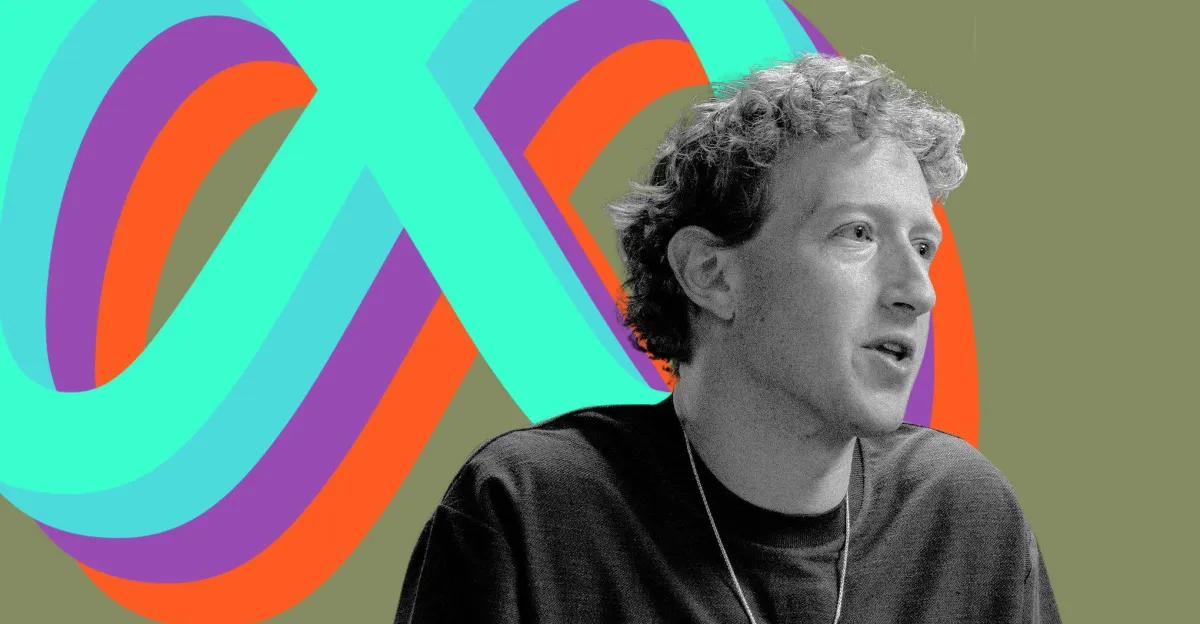
I bring this up because Mark Zuckerberg has posted a manifesto that he — or his communications team, or possibly an AI — wrote. The point of this 6,500-word essay is to define a positive future for AI. It strikes me as an inauspicious sign for AI that a new, supposedly world-changing and value-creating technology should need such a defense, but AI has been getting bad press these days. People hate data centers, and the higher electricity bills that come with them. Anthropic CEO Dario Amodei has said the technology may cause “unusually painful” job losses across multiple industries. OpenAI CEO Sam Altman’s house was the target of, first, a Molotov cocktail, and then gunfire.
“It is surprising that the discourse from many developing AI is so filled with doom,” the essay says. “I do not understand why anyone who believes that AI will eliminate most jobs and much of humanity’s relevance would rush to build that future.”
I find it difficult to believe that Zuckerberg doesn’t have Amodei’s phone number. Or Altman’s. I know he has Elon Musk’s — I’ve seen their texts in court. Perhaps he should have texted them to ask!
Anyway, Zuckerberg is trying to be the soothing tech guru, here to tell us that things are going to be okay. He’s addressing, however belatedly, the rage that many people feel about AI. There are sections on data centers (Meta is building power sources for some data centers in the future, but don’t ask for renewable energy) and “preventing government tyranny.” This essay exists to try to quiet the AI backlash — even if it never quite says that directly.
Love is not just a feeling; it is a way of paying attention
We will leave aside the question of “superintelligence,” which is Zuckerberg’s preferred term for what the rest of the industry calls “artificial general intelligence”; let’s stipulate, for the purposes of this essay, that it is indeed possible to create. I am also going to ignore the risible defense of the pervert glasses contained in this piece; they are indefensible. As for the risks, I think they are best addressed elsewhere. What I am interested in is what Zuckerberg — or whoever is writing for him — believes will improve all our lives.
Here is his first pitch: “Everyone will have an exceptionally capable personal agent that understands you, your goals, and everything you care about. Your agent will work 24/7 on your behalf to improve your relationships, health, career, finances, home management, hobbies, and more.” I am struck, here, by the inclusion of “relationships” and “hobbies.”
What strengthens a relationship? Almost always, it is personal investment. Perhaps an AI agent might be better at predicting what my father will want for his birthday than I am, but it definitionally cannot give him my time and consideration. Love is not just a feeling; it is a way of paying attention.
Zuckerberg’s vision of maximizing productivity comes at the cost of my experience
Zuckerberg uses an example that is telling, in a grim kind of way: He asked an AI to pick out a “personalized” recipe to bake with his daughter. He could have considered what kind of baking his daughter enjoys, what her skill set is and what he might be able to teach her, then picked a recipe. Maybe he would have picked a bad recipe, and they would have bungled it — but that might have been a fun experience and a good story. Or maybe he would have picked a family recipe, and it would have given him the opportunity to tell her about when he was a child, or what his grandmother was like. Certainly he’s a busy man, but wouldn’t that make the gift of his attention to her hobby even more precious? Perhaps he might have come to understand her better by spending more time thinking about what she likes. Without that attention, the baking they do together seems more focused on accomplishment than quality time.
Relatedly, the point of a hobby is that you do it. Granted, many of my hobbies are physical activities — hiking, running, yoga, rock climbing (with guys who make bad AI art, apparently). But an AI cannot read a book for me, because the activity of reading a book is absorbing its words into my mind; a summary doesn’t do the same thing as the opening lines of Renata Adler’s Speedboat: “Nobody died that year. Nobody prospered. There were no births or marriages. Seventeen reverent satires were written — disrupting a cliché and, presumably, creating a genre.” The summary cannot summon the mood, nor the actual pleasure of reading the words themselves. An AI cannot replicate the soothing quality of knitting my own scarf; it is the knitting itself that soothes.
Zuckerberg suggests that using an AI to assist me in these tasks will let me accomplish more, and that is probably the case. But I always thought the point of a hobby was to relax and enjoy myself. It’s certainly not to maximize productivity. And Zuckerberg’s vision of maximizing productivity comes at the cost of my experience.
This is the guy that had every resource anyone could wish for at his fingertips and his metaverse still flopped
The second thing Zuckerberg presents is “Everyone will have incredible tools for creation to express your ideas.” I would suggest that everyone already has incredible tools for creation to express their ideas, and that one need merely practice with those tools in order to get better at them. The pleasure of, say, learning to make a video is, first of all, making the video itself — who hasn’t had fun goofing around with friends while filming? But it is also getting better at the tools one uses to make the video, and looking back at one’s efforts as one’s directorial eye improves. Sure, this is time-consuming and requires effort — it can’t be done in a single evening — but isn’t that what makes it rewarding?
Similarly, Zuckerberg introduces the unimpressive notion that everyone gets “powerful tools to create new businesses.” This is the guy that had every resource anyone could wish for at his fingertips and his metaverse still flopped. Maybe more ideas can turn into businesses, but not every idea will be a successful business, and the sheer volume of competition may make it much harder to succeed. That is, assuming those powerful tools work as promised. After all, just recently, Meta announced that its AI had hacked another company, following similar incidents from OpenAI and Anthropic. Not only will your own personal company have to deal with such hackers, you may inadvertently engage in corporate espionage yourself. Is that really what every entrepreneur wants to sign up for?
Let’s move on to the next absurd idea the manifesto introduces: Everyone gets a “personalized tutor and coach with a PhD in every subject.” Again, for the sake of this essay, pretend that is possible. We have already tried computerized learning, in 2020, and if I recall correctly, it was a spectacular failure. People don’t like it. Kids don’t like it. Teachers are still coping with the fallout. And I hate to do another victory lap on behalf of Aristotle, but it sure seems like having a mentor (phronimos) is really important when it comes to learning, ethical or otherwise. The social part of learning — whether that’s the peer pressure of being in a class, or the need to impress someone you admire — seems indispensable to the experience.
Everyone is equal in AI but some people (the ones with money) are more equal than others
The strongest thing that Zuckerberg suggests, in my view, is the notion that everyone can benefit from and contribute to scientific advances. Now, I benefited from the polio vaccine — among other scientific advances — at least in part because Jonas Salk chose to make it available to everyone without earning any money from it. But never mind that. I am curious about what it means to contribute to scientific advances in this sense.
Zuckerberg gives some vague handwaving about personalized therapies, which have long been a goal in medicine. Again, let’s assume AI can even do this. I notice, however, that personalization is possible only when doctors have enough time to actually listen to their patients. It also means that patients will need to have the means to pay for personalized medicine, whether through their insurance or otherwise. But this bit from the essay is vague enough that he may actually mean that AI will allow researchers to harvest samples from all of us and test things more quickly, which has its own haunting privacy implications, especially coming from Mark Zuckerberg.
For his final point, Zuckerberg outlines the current state of affairs: Everyone is equal in AI but some people (the ones with money) are more equal than others. The best models will remain paywalled, accessible only to the rich. But what if everyone had free access, he wonders. You mean like they do right now, Mark? How on earth does making the status quo permanent improve our lives?
Consider all this against Terence Tao’s narrower vision of what AI is for in mathematics. He asks us to imagine the following statement is true: “AI tools will, reasonably soon, become capable of performing a reasonable fraction of research-level mathematical tasks, with reasonable levels of success, quality, supervision, and cost.” Tao then stops and asks a crucial question: What are our goals?
I am coming to believe we need a better quality of AI booster
It is the question that Zuckerberg’s vision of the future doesn’t ask. For each thing Zuckerberg outlines as a possibility, the presumed outcome is some kind of accomplishment. The possibility of pleasure, of experience, of self-knowledge or self-expression are missing from this vision.
In contrast, one of the possibilities Tao outlines for the field of mathematics — if an AI can simply solve mathematical problems at will — is that its goal is to help people understand and do math. This accomplishment is perhaps somewhat squishier than “solve a problem,” but only because it is more profound. It speaks to what we understand knowledge to be: not merely the collection of answers to questions, but the understanding of why those are the answers — a deeper way of connecting with the world and with ourselves. This sounds suspiciously like the humanities, doesn’t it?
Look, I am coming to believe we need a better quality of AI booster, because while I understand the Zuckerberg statement exists mostly to cheerlead Meta’s own AI investment, I have heard similar things coming from people who don’t have similar financial interests. Is the point of life merely to stockpile accomplishments? If that is what Silicon Valley believes, no wonder all the billionaires seem so unhappy all the time! They have traded experience for accomplishment, and cheated themselves out of their own lives in the process. They keep chasing more money and more power, because they think that will finally be enough — but as long as they do not experience things themselves, nothing will ever be enough.
What does it mean to live a good life?
When I am reading a book, or listening to music, or watching a movie, I am not just consuming a resource. I am experiencing other people’s minds. Artists have signature styles not merely as branding exercises but because they are expressing something about how they view the world, what they think beauty is, and what they believe to be the point of art. In prose, word choices are a kind of thumbprint for a specific person. In music, phrasing is another. In visual art, brush or pen strokes. Part of the point of the encounter is the aesthetic vision; the quality of another person’s attention. Part of it is your own attention: Does the artist’s aesthetic speak to you? What have you learned about your own aesthetics from it? What does beauty mean to you? What is pleasure?
If AI can do all the things we are promised it will do — hardly a given, but stick with me — then we are left with a question: What does using it accomplish? If you do not have to pay attention or do work to meet your goal, does your goal mean anything at all? In some ways, that throws us back to some of the oldest and most profound questions our species has encountered: What does it mean to live a good life? How do we love others? What does it mean to love ourselves?
Which brings me back to my climbing buddy’s motivational poster. What is there to say about something he did not create? It expresses very little of him. It took only seconds and required no attention, devotion, or even thought. The main thing I took away was that he requires a reminder to do cool shit — which, at least in my view, hardly requires a reminder at all.