



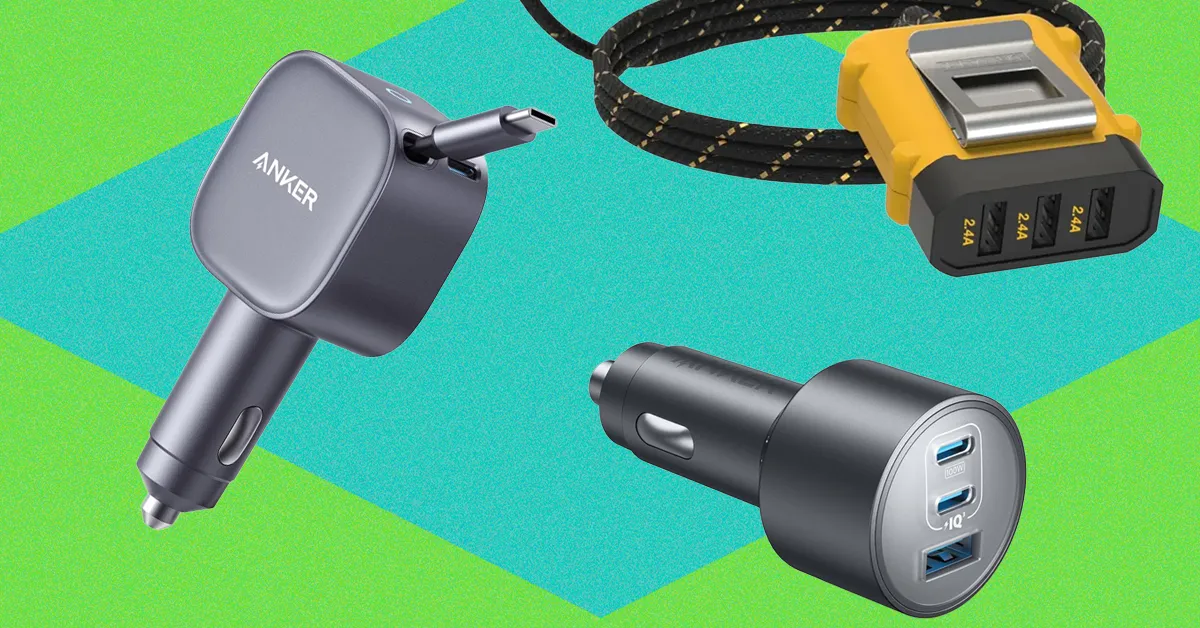
Anker is a brand I trust for charging technology. But it’s worth noting that retractable cables introduce a couple failure points that could lower longevity. The cable can’t be swapped out if it gets worn, and the retraction mechanism itself could wear out. Tidiness has a price, it seems. This said, the charger is not overly expensive, usually retailing closer to $20.
Best Front and Back Seat Car Charger
-
Photograph: Matthew Korfhage
-
Photograph: Matthew Korfhage


DeWalt
72W Front and Back Seat Charger
WIRED
- Front-and-back seat ports for family use
- Five ports overall, with 30-watt USB-C up front
TIRED
- Back-seat chargers are USB-A only
- Aesthetics are aggressive
The modern car family involves a nest of devices—parents in the front seat charging phones, children in the back with tablets, somehow watching the same thing over and over. And nothing ends the peace of a road trip quite like a tablet running out of juice halfway through an episode of Bluey.
This DeWalt is a good solution, offering decent (but not great) 30-watt charging on the USB-C port for front-seat parents, and a couple of auxiliary USB-A ports to keep maintenance charge on backseat devices. DeWalt is a power tool brand, of course, and so these ports were likely designed for a tool or two resting in the back seat. But kids have tools, too, and this’ll serve their needs.
It’s perhaps frustrating that the back seat chargers are USB-A. But I haven’t found a good USB charger with a back-seat USB-C charging setup, assuming your car doesn’t have a back seat charger of its own. And so while this DeWalt is a compromise, it’s the best compromise I’ve found so far.
Frequently Asked Questions
How I Selected and Tested USB Car Chargers
For this round of car-charger testing, I looked first for known quantities and trusted charging technology brands like Anker, Belkin, and Ugreen. I also ordered and tested devices that other credible sources had ranked as their favorite USB chargers, making sure that each charger is broadly available and easy to find. Needless to say, I only assessed and recommend UL-certified chargers, and avoided dodgy-looking brands: Short circuits in cars aren’t fun, for me or for you.

Photograph: Matthew Korfhage
I then set about testing the claims for each car charger, using ammeters for each port on each charger, testing with an ammeter while pulling max loads. I additionally used the Ampere phone app to test the peak draw for a Motorola Razr and an iPhone 13, and also tested to see whether the charger heated up while pulling max draw—both using the phone app and an infrared thermometer.
I tested with each charger’s included cord, where relevant, but also with a fast-charging cable on USB-C devices that advertise this capability. For my top contenders among 100-watt fast chargers, I also tested to see how long it took to charge a Macbook Air M4 and my top-pick jump starter, the 4000A Wolfbox.
As with every device tested by the WIRED Reviews team, I subjected my top-pick chargers to real-world road tests. I went on multi-hour road trips with devices plugged in. I charged portable jump starters or laptops while also charging phones. I tested durability in real-world conditions that may also involve grubby fingers. I assessed each device not just for brute speed, but for versatility in different use cases. For now, I favor chargers that offer both USB-C and USB-A capability, so as not to leave any devices out in the cold.
I also checked up on customer reviews for each of these chargers. If I saw any customer complaints, I tried my darndest to replicate them. I jammed chargers in and out of the ports, and wobbled the chargers around in their sockets. I acted the way people act when they’re fumbling for a device charger they’re not looking at while driving.
Are Cheap USB Chargers Unsafe?
I’ve put a bit of emphasis on trusted brands while testing USB chargers, and this isn’t by accident. The world is full of dodgy gas station or Amazon chargers, and bad cables, with insufficient electrical insulation and inconsistent current delivery.
Bad USB-C cables and electrical insulation are known fire hazards in the worst cases, but inconsistent voltage is also just bad for your phone or laptop battery over time. Poorly made chargers, connectors, and cables can have higher resistance (leading to overheating), bad or inconsistent connections, and poor protections against shorts and surges. All of these things are bad. At worst, they can fry your device or lower your battery longevity.
As a rule of thumb, look for language that a product is “UL-Listed” or “UL-Certified” not merely “UL-Classified” or “Recognized.” The latter two mean that a product has been tested only against specific hazards or under specific conditions. Listed and Certified products have fully passed all tests within a given standard. WIRED will only recommend chargers that are UL-listed or -certified.
Other USB Chargers I Recommend

Photograph: Matthew Korfhage
Scosche PowerVolt 60W Dual-Port Charger for $20: This dual-port USB-C charger from California car brand Scosche is the simplest thing imaginable. Two USB-C ports, each separately rated at 30 watts. Each charges quickly and is reliable. Though this Scosche doesn’t offer a fast-charging option for laptops, it’s perfectly optimized for a pair of phones—and admirably low-cost. If you’re mostly just going to charge a phone, this is a tight runner-up to my top-pick Anker—especially if you’re pretty sure you’ll never need a USB-A charger in your car.
Anker 40W Two-Port Charger for $20: Like the Scosche, this Anker is a purpose-driven phone charger with two USB-C ports. It’s a little lower-powered than the Scosche, with a little less juice than the newest generation of phones can support. But the price is right if you’re willing to accept lower charging speeds.

Photograph: Matthew Korfhage
Belkin BoostCharge 42W Dual-Port Charger for $24: This compact, well-insulated dual-port charger from California tech accessory brand Belkin is great as a budget option, with decently fast USB-C and USB-A charging. Just note that the tiny device might be a bit shallow for some deeper car chargers, and that when plugged in, the charger has a nonnegotiable and oddly bright LED light that stays on even when no device is charging. This won’t bother you unless it bothers you.
Nekteck 45W Two-Port Car Charger for $32: This basic, bare-bones Neckteck charger is a decent compromise for those who need fast charging on a QC 3.0-compatible USB-A device. While a 45-watt max speed for USB-C charging isn’t fast by modern standards, it’s still faster than most phones. And the QC 3.0 USB-A charger is significantly faster than most USB-A chargers, for those with older devices.