



The driving force behind our universe’s accelerated expansion remains one of the greatest mysteries in astronomy. While this force, which scientists refer to as dark energy, pervades our universe, we know almost nothing about it.
Located on a remote mountain in Arizona’s Sonoran Desert, the Dark Energy Spectroscopic Instrument (DESI) has spent the past five years mapping the cosmos with the goal of unraveling this mystery. The result is the largest three-dimensional map of the universe ever created. And now—with the release of the latest version of the DESI Legacy Imaging Surveys, a free online tool for exploring the vast imaging data—you too can poke around the universe.
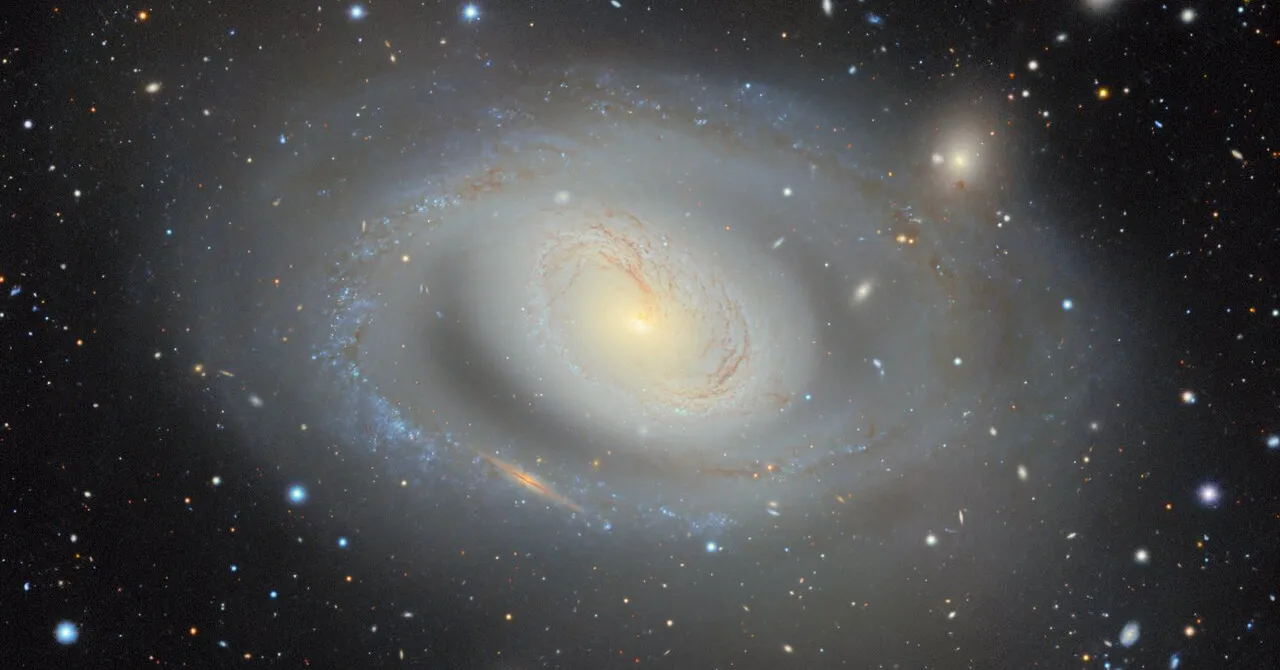
The new map boasts an overwhelming amount of information: 5.6 trillion pixels containing approximately 4 billion celestial objects including stars, galaxies, black holes, and asteroids. It covers approximately 75 percent of the entire sky, recording both visible light and near-infrared wavelengths.
Those missing pieces include the deeper parts of space blocked by the stars, space dust, and other matter in our own galaxy, which is a major challenge for astronomy surveys, especially ground-based ones. However, since the Milky Way is splayed out like a fried egg—which is why it appears as a dense band of stars in the night sky—the researchers aim DESI’s 5,000 mechanical eyes out of the top or bottom of our galaxy to capture some of the clearest images of distant space yet.

Though this particular survey lasted five years, it built on another 13 years of groundwork. More than 160 scientists were involved in data collection, and over the course of the project, researchers have already published upwards of 1,800 scientific papers referencing the data.
“It’s part of the fabric of astronomy research now,” David Schlegel, a researcher at the Lawrence Berkeley National Laboratory and co-lead of the Legacy Surveys, said in a press release. “When you’re working with astronomical objects today, you often start by pulling up the Legacy Imaging Viewer to see what you’re looking at.”
Earlier this year, DESI researchers released another map, which projected the distances of 47 million galaxies and quasars. This reconstructed 11 billion years of cosmic history, bringing the effects of dark energy into focus. Dark energy is thought to be responsible for the expansion of our universe, and while the force itself remains ellusive, astronomers can track it by analyzing the rates at which other celestial objects appear to be moving away from us.