



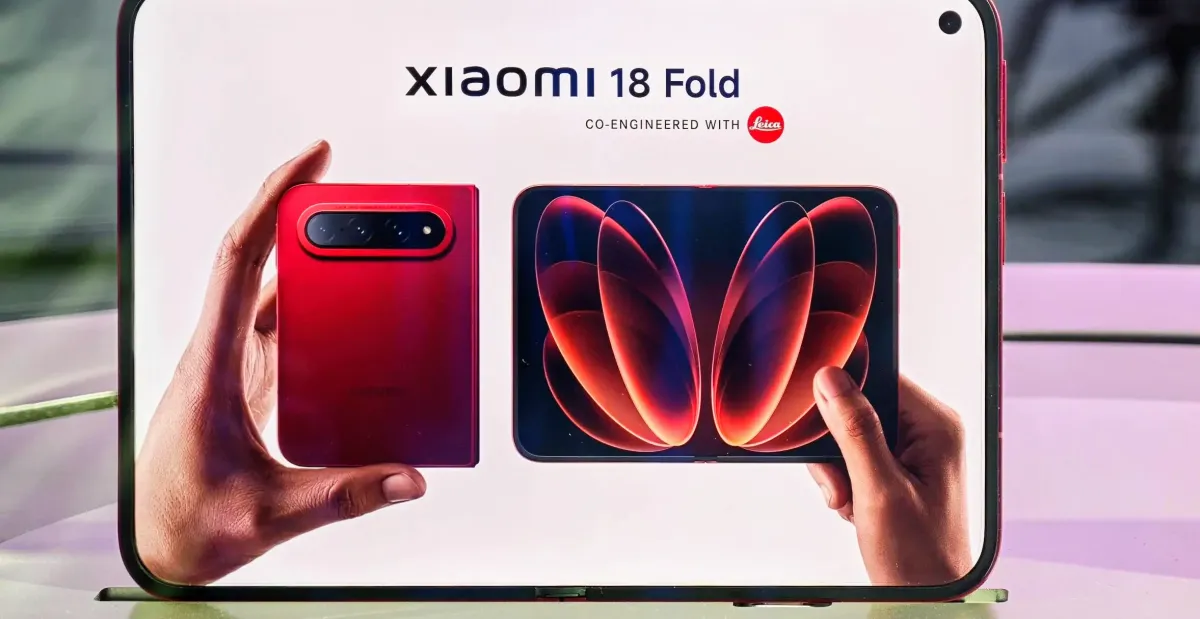
China is getting first crack at a British technology that might change how mobile games are made and played. Today, the Xiaomi 18 Fold launches in mainland China with an Arm Mali G2-Ultra NX graphics processor inside its custom Xring O3 chip. What’s so special about that? After five years of development, Arm now has an AI gaming graphics accelerator inside its GPU.
By following Nvidia’s playbook, Arm-powered phones are about to have PC-like technologies to make games run faster, at higher resolution, with advanced lighting techniques, all without using more power than they do today. The jagged edges you see in the mobile versions of popular games might begin to go away.
And these advancements won’t just be locked to Chinese phones. The chips, devices, and games are already inbound.
“You will be able to buy it; you will be able to get it in phones next year, you will be able to get it in other types of larger screen devices, whether that be tablets or Chromebooks,” Arm’s Chris Bergey, EVP of Edge AI, tells The Verge in an interview.
While he can’t say which other devices will contain the Mali G2-Ultra NX, he hints that some of Google’s upcoming Googlebooks might use this graphics tech as well.
“We think it’s going to be huge,” Bergey tells me.
There are two ways to look at Arm’s new Arm Mali G2-Ultra NX. One is that it’s stronger than prior mobile GPUs, period, with an alleged 85-percent performance increase over the GPU that Xiaomi was using previously, and a 14 percent increase over Arm’s previous flagship in “non-AI gaming.”
But the other, more important way is that it enables a suite of hardware-accelerated graphical techniques that sound very similar to Nvidia’s DLSS, including AI upscaling (where it imagines a higher-resolution image), frame generation (where it generates new “fake” frames between existing ones), and even ray reconstruction like Nvidia’s DLSS 4.5.

Arm is calling all of these techniques “neural graphics,” but it doesn’t mean quite the same thing as when Nvidia uses that term — we’re not talking about enhancing faces by reimagining how light and shadow work, at least not just yet.

Instead, these improvements are about speed, offering what Arm claims is up to four times the framerate when “Neural Super Sampling,” “Neural Frame Rate Upscaling” and “Neural Denoising” are all applied simultaneously, because each technique lets the system do less work rendering actual pixels and frames, counting on AI to fill in the rest.
Note that games likely won’t feel four times faster, though, even if they look that way. Half of the boost is because your phone will imagine new frames between existing ones — and when Nvidia, AMD, and Intel do “frame generation,” it typically comes with the cost of additional latency.
Regardless, these techniques won’t all arrive immediately. “The first titles will largely be super sampling,” says Bergey, with frame gen coming in early 2027 and denoising “soon after that.”
But when you put them together, he says a phone can now genuinely play an experience like this Neural Dawn technology demo, below — and without draining your battery fast. “It might be like, hey, you can now play 1080p, 60 frames per second for three hours,” Bergey tells me. “In the past, it was 30 minutes.”
With the Xiaomi Pad 9 Pro Max tablet, which pairs Arm’s GPU with a larger battery, screen, and surface area for cooling, may offer even more performance. The Chinese company is showing off 3.2K resolution at 120 frames per second.
Bergey says that an entire phone with these chips will consume no more than 2.5 watts, with only 1.5 watts allotted to the GPU. “That’s basically what you want for real sustained gaming where it’s not getting warm in your phone, you’re not like ‘Oh, where’s my charger,’ that kind of thing,” says Bergey.
Or, he says, device and chipset makers can run this GPU at lower wattage to last longer. It’s not just for gaming phones: “This is not overclocking, this is mainstream,” he says. “This is about AI replacing traditional rendering; anywhere you can use it, you will use it,” he says.

It’s not just for premium phones and tablets, either: “While Mali G2-Ultra NX targets flagship smartphones, neural graphics will also be available across the Premium and Pro configurations, bringing the technology to a broader range of mobile segments and tiers.”
Arm isn’t the only one attempting to push these speed-boosting PC technologies into the mobile realm. The developers of the graphically intensive Stellar Blade, for example, recently revealed they’re making their game run at 60fps on the Nintendo Switch 2 by using both Nvidia’s DLSS and a version of AMD’s frame generation technique. The Switch 2 has an Arm-based mobile chip too, though it contains a custom Nvidia GPU.
Like with the most advanced versions of Nvidia, AMD, and Intel’s techniques, game developers will need to integrate Arm’s features into their games, though participating game engines like Unreal Engine and Unity can help. Bergey doesn’t think it’s a switch gamers will be able to flip for just any game they like.

Where Winds Meet, Infinity Nikki and Arena Breakout: Infinite are the first three games confirmed to take advantage of Arm’s new graphics accelerator, and Bergey tells us more games are on the way. Some will be announced in the coming weeks, he says — he’s just not allowed to reveal them quite yet.