



Apple announced the company’s first device with a folding screen today, the iPhone Duo, but that’s where the firsts end. The Duo is not only far from the first foldable on the market thanks to the efforts of Samsung and Google, but it’s also not the first product to be called the Duo.
Former Apple CEO Steve Jobs popularized the saying “good artists copy, great artists steal,” but will the iPhone Duo’s folding screen, which features a custom nano-texture display material to help minimize the visibility of its crease, be enough to make us forget these other Duos that have come before it? Only time, or how aggressively Apple plans to market its Duo, will tell. Is there a Duo we missed? Let us know.

Merging the functionality of the TurboGrafx-16 console and the TurboGrafx-CD that added CD-ROM functionality, the NEC TurboDuo (later rebranded to just the Duo) launched in North America in 1993 after debuting in Japan a few years earlier as the PC Engine Duo. The console was developed as part of a joint venture between NEC and Hudson Soft but never reached the popularity of the original TurboGrafx-16; its short run ended on Christmas Day in 1995.

Photo by Dieter Bohn / The Verge
First released in 2016 and eventually merged into Google Meet in 2022, Google Duo was the company’s proprietary VoIP service meant to compete with products like Skype or Zoom and replace Hangouts. Its cross-platform availability included Android and iOS mobile devices as well as web browsers, and while it supported hi-def video calls, the service was also optimized for slow mobile networks.

The iPhone Duo isn’t even Apple’s first Duo. The PowerBook Duo predates everything Apple announced today by decades. It was an ultraportable laptop, and when Apple introduced it in 1992 it was the smallest and lightest PowerBook available, but still weighed over 4 pounds. Apple managed to shrink the Duo using an approach it still uses today: omitting built-in ports and expansion features. If you wanted to connect peripherals and accessories you had to rely on optional docks. If you’ve ever had to buy a USB hub to connect all your devices to your MacBook, you can thank the PowerBook Duo.

Photo by Dieter Bohn / The Verge
Twenty-three years after the PowerBook Duo was discontinued, the company announced the MagSafe Duo charger that could wirelessly charge an iPhone and an Apple Watch at the same time. However, it felt like a consolation prize for the Apple AirPower wireless charger, which was announced in 2017 but never materialized. The MagSafe Duo was discontinued just a few years later in late 2023, paving the way for the foldable iPhone to steal its identity.

Photo by Amelia Holowaty Krales / The Verge
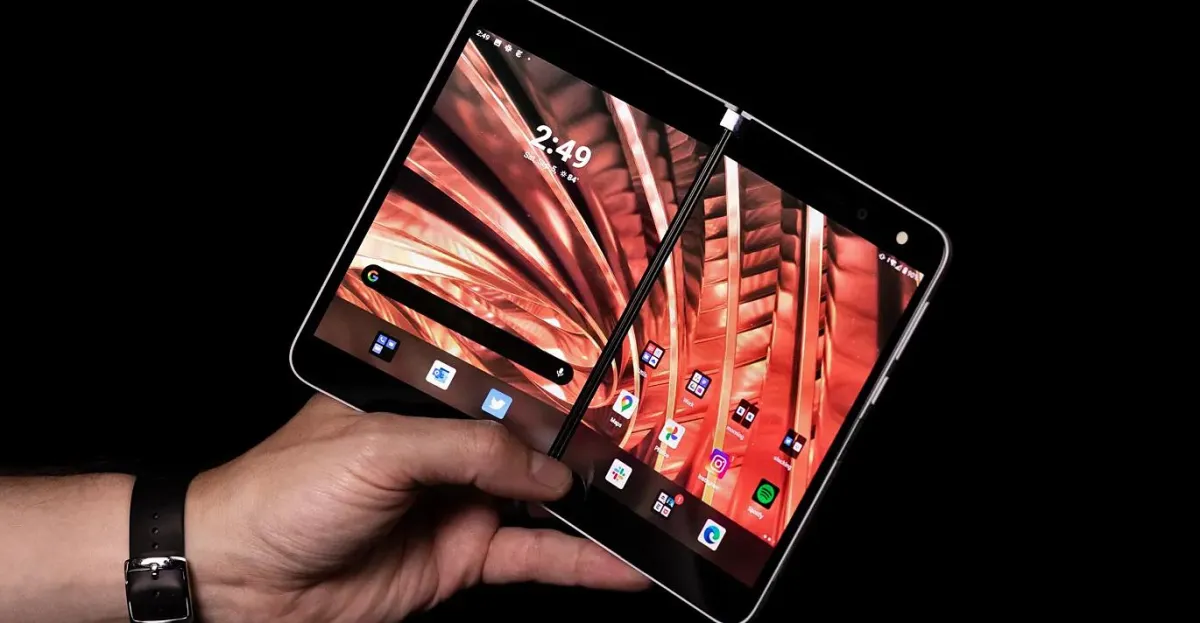
That’s right, the iPhone Duo isn’t even the first folding mobile device to be called the Duo. Microsoft’s Surface Duo launched in 2020 and managed to get around the issues with early foldables like the Samsung Galaxy Fold, which debuted a year prior, by skipping flexible screen technology altogether. Microsoft’s Duo instead had a very visible hinge between its pair of 5.6-inch OLED screens. But software issues, a disappointing camera, and outdated specs when it launched all resulted in the Surface Duo’s failure, even with an improved Duo 2 that launched a year later.

Photo: Antonio G. Di Benedetto / The Verge
Trade shows are the birthplace of weird laptops, but sometimes the prototypes that often debut just to draw visitors to booths make it into the mainstream. Such was the case with the Asus ROG Zephyrus Duo, a powerful gaming laptop with excellent specs, a wildly expensive price tag, and a pair of 16-inch OLED screens that can be vertically stacked or placed side by side.

Photo: Amelia Holowaty Krales / The Verge
The ROG Zephyrus Duo wasn’t Asus’ first attempt at creating a dual-screen laptop, or the first time it named a laptop a Duo. The ZenBook Pro Duo predates it by several years with a slightly different design. Beneath the ZenBook Pro Duo’s primary 15.6-inch OLED screen was a secondary 14-inch display located above the laptop’s keyboard. With an ultrawide 32:9 aspect ratio and less color fidelity, the smaller screen was designed to be a place to dock productivity tools like Slack or Gmail so they were still readily accessible but less of a distraction while working (or gaming) on the primary display.

After convincing Google to open-source the Pebble’s operating system last year, Eric Migicovsky, the creator of what was arguably one of the first truly successful and capable smartwatches, resurrected the wearable under a new company called Core Devices. The Pebble 2 Duo, one of the first smartwatches from Migicovsky’s new company, isn’t as capable as the Apple Watch or devices running Android’s Wear OS, but its careful balance of simplicity, functionality, and a budget-friendly price make it a tempting alternative.

Photo: Jennifer Pattison Tuohy / The Verge
It’s still just a prototype and may never find its way into consumers’ homes, but at IFA 2026 in Berlin last week, iRobot debuted the bizarre Roomba Duo. The prototype includes a beefy mobile dock with clean and dirty water tanks and the most powerful floor-cleaning suction the company has ever made. To ensure it can clean all areas in your home, atop the Roomba Duo is a deployable garage with a smaller Roomba Plus 757 inside that can easily fit into tight spaces and beneath furniture.

Image: Retroid
Mere hours before the iPhone Duo made its debut, Retroid revealed the full design of its latest dual-screen handheld it’s been teasing. The Retroid Pocket Duo is a modernized version of the Nintendo DS with dual 120Hz OLED screens featuring a 16:9 aspect ratio on top and a 4:3 aspect ratio between its controls. Full specs and pricing aren’t confirmed yet, but the Pocket Duo features a symmetrical dual thumbstick design, two pairs of shoulder buttons, and a headphone jack.