



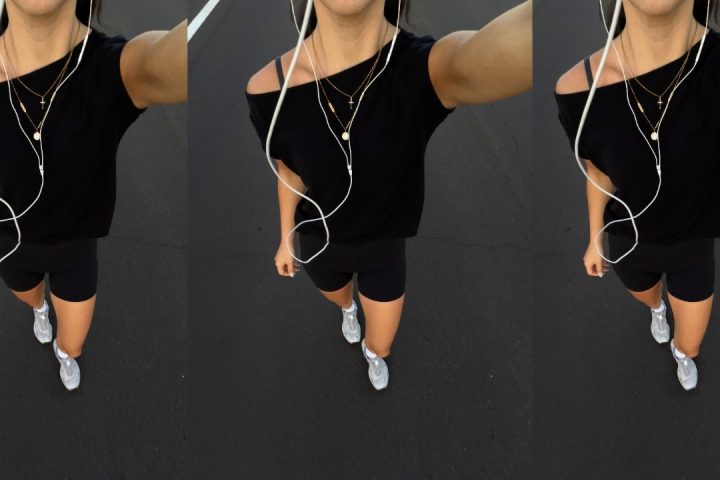

I used to be the queen of 6 A.M. heated Pilates sculpt workouts. An unlimited Pilates membership hated to see me coming—once that (alarmingly high, I live in Los Angeles) monthly fee came through, you better believe I’m doing the math and getting the most out of it; I barely ever missed a day. And for a while, I actually enjoyed the intense heating classes–until I didn’t. I felt myself getting stronger, but I was also constantly bloated and exhausted, not energized like everyone promised I would be.
Here’s the problem: I assumed exercise must work on a more-is-more approach: If exercise was good for me, exercising more must be even better, and TikTok promised that a morning workout class was the key to stay consistent and my healthiest. But while I felt good about my workout routine, I hadn’t changed any of the other habits that actually helped my body recover. I’d stay up late, get four hours of sleep, then wake up at 5 a.m. and eat a processed protein bar half-asleep before rushing out the door for class. I was putting more and more stress on my body without giving it a chance to recover.
I don’t consider myself easily influenced by celebrities, but Dua Lipa is the exception (her outfits! her vacations! her vibe!). I assumed she must have a strict, regimented workout routine, but in a 2025 interview with VOGUE, she revealed that getting on her mat every day is what keeps her grounded and fit. Her advice? “Don’t overthink it!” Sometimes that means Pilates or yoga, and sometimes it’s simply a 20-minute mat routine.
So with an exhausted body and some inspiration from Dua Lipa, I ended my membership and instead rolled out my mat and moved for just 15 minutes in the morning. No heated studio, no instructor, no hour-long class, no early wakeup time—just a slow, simple morning routine that combined some of my favorite Pilates exercises with yoga poses and stretches. And somehow, doing less started making me feel better than doing more ever had. After replacing my intense morning class with 15 minutes of gentle, easy movement, I was seeing and feeling results that months of pushing myself through studio classes had never given me—and I needed to understand why.
“The results illuminated how my Pilates princess era kind of missed the point…”
Experts Consulted
At The Everygirl, we believe that wellness advice should be grounded in accurate, science-backed information to ensure our readers can make informed decisions about their health and well-being. That’s why we prioritize consulting trusted, credible experts—so every piece of content is both reliable and empowering.

Once a professional dancer, Vicario transitioned into a career in fitness and is currently the VP of Talent and Training at PVOLVE, a functional movement-based fitness method. She collaborates with a Clinical Advisory Board of medical experts to create science-backed workouts that meet members’ needs

Maryam Ajayi is the founder of Dive in Well, a boutique agency driving impact at the intersection of wellness and culture. She has been featured in outlets such as The New York Times, The Sunday Times, VOGUE, Goop, and The Cut.

Lee Holdcraft is the cofounder & CEO of Practice Room, an infrared sculpt, Pilates, and yoga studio based in NYC.
Why Slower Morning Movement Might be Better for You
Cortisol load & recovery are missing pieces of the puzzle
Especially for high-achieving women, cortisol is often running our lives, and it impacts how we need to move in the morning. Cortisol is an essential hormone that follows a natural daily rhythm. Research shows that cortisol levels typically rise rapidly within the first 30-45 minutes after waking, a phenomenon known as the cortisol awakening response, meant to help your body get energy for the day.
Exercise is another form of physiological stress, and moderate- to high-intensity exercise can temporarily increase cortisol levels, while lower-intensity exercise may not produce the same response. And when my day involved more and more stress with tight deadlines and long to-do lists, I don’t think spiking my cortisol when it’s already elevated in the mornings was the best thing for my anxiety and stress levels.
That doesn’t mean an early morning workout is automatically “spiking your cortisol” in some harmful way for everyone, or that everyone should trade HIIT for stretching; research examining exercise and the cortisol awakening response is still limited and inconsistent. The more relevant question for me wasn’t whether working out at 6 A.M. was inherently bad; it was whether the intensity of my routine made sense alongside everything else I was asking of my body. I was sleeping four hours a night, dealing with everyday stress, and sometimes exercising twice a day without prioritizing recovery. My workout or timing wasn’t necessarily the problem, but the bigger picture clearly wasn’t working for me. “When training outpaces recovery, your nervous system stays stuck in overdrive and sleep suffers,” added Lee Holdencraft, certified trainer and CEO of Practice Room in NYC.
Exercise “snacks” make a difference too
There’s also evidence that shorter bouts of movement can have meaningful health benefits, which is why so-called “exercise snacks” have become increasingly popular. A 2019 study in Applied Physiology, Nutrition, and Metabolism showed that movement snacks as short as 20 seconds can still contribute to fitness improvements as long as they’re done regularly. Our toxic fitness culture has told us for years that it needs to be a 60-minute intense sweaty workout to “count,” but research tells us something else: shorter, lower impact bursts of movement (see: 15 minutes of gentle yoga and stretching in the morning) have benefits too.
Plus, overtraining is more common than we think, even with workouts we tend to think of as lower-impact like Pilates or yoga. “Being intentional and consistent is much more productive than pushing to your limit,” recommended Antonietta Vicario, founding trainer and chief training officer at Pvolve. “Constant high-intensity training often keeps the body stressed, inflamed, and under-recovered.”
Once I stopped measuring a successful workout by how early I woke up, how long I exercised, or how exhausted I felt afterward, I could finally figure out the kind of movement that actually made me feel best.
“Once I stopped measuring a successful workout by how early I woke up, how long I exercised, or how exhausted I felt afterward, I could finally figure out the kind of movement that actually made me feel best.”
My Results from Swapping 6 A.M. Pilates Classes for 15 minutes on the Mat
After just days of replacing my 6 A.M. class with 15 minutes on the mat, I felt the benefits of stretching out my specific problem area and strengthening the parts of my body I wanted to. Instead of constantly feeling tight and worn down, my body started to feel more open, mobile, and supported. Spending more time stretching the areas that actually needed attention helped release the tension I was constantly carrying in my shoulders and legs, while slowing down during core exercises allowed me to focus on my form in a way I never did when I was rushing to keep up in class. I even started noticing myself standing taller as my posture improved. Ironically, when I stopped trying so hard to change what my body looked like and started paying attention to what it actually needed, I began to feel stronger and more comfortable in my body than I had during my most intense workout era.
But the changes didn’t stop at my physical body. I noticed changes in my life, from my routines and productivity to my mindfulness and overall contentment. I spoke to Maryam Ajayi, a wellness and social impact founder as well as a breathwork practitioner, to understand why. She explained slowing down and doing gentle exercises that require deep breathing can have effects on your nervous system and energy levels. “Science shows that breathing into your belly slows down your blood pressure and relaxes your nervous system.” But breathwork isn’t just about the mechanics. It’s about the empowerment that comes from connecting to your body on your terms.
Holdencraft agreed, noting that the benefits I felt likely came from listening to my body instead of mindlessly going through a class: “Listen to your body,” she recommended. “Pick the one thing your body actually needs that day, whether it’s your spine, your hips, or just slow breathing to calm down, and spend the full fifteen minutes there instead of rushing through a full-body class.”
The results definitely illuminated how my Pilates princess era kind of missed the point. I was trying to be my vision of a Pilates girl, not myself.
As a Black woman, I also learned that my demographic is more likely to suffer from stress-related illnesses. And while much of that stress is caused by external factors we can’t control—from generational trauma to daily microaggressions—experts recommend leaning into what we can control, like our routines and our ability to build self-esteem through habits. For many of us, that healing starts by carving out time for ourselves. “Rigidity only adds pressure onto us—who needs that in today’s world?” Ajayi added. “The discipline is coming back to it; not what it looks like.”
Don’t get me wrong—I still love a heated Pilates workout (bonus points if the studio has red light). But I learned that 15 intentional minutes in the morning personalized to my own body’s needs are way more effective than an hour in the studio. Finding what works for you might take you to the studio. You might even take my spot in that very 6 A.M. class. Meanwhile, I’ll be unrolling my mat for a quick 15-minute routine that helps me come back to myself in a way that is restorative, not restrictive.
My Exact 15-minute Workout I Do Instead
When I started, I only had one requirement: show up to the mat for 15 minutes. Day by day, I changed the movement as my body changed: Where did I feel achy? What craved movement? Which stretches did I want to stay in longer? How could I move in a way that left me feeling better instead of simply more exhausted? (a far cry from following an instructor or trying to get through as many reps as possible in 60 minutes). I would add in my favorite Pilates moves but focused on the breathing rather than the results.
Over time, I developed a 15-minute routine that is a mix of my favorite parts of Pilates and yoga—a combination I hope would make Dua proud. I am drawn to the discipline of Pilates, with the focus on form and getting to the bottom of my breath helping me articulate each move. But I also wanted to add my favorite yoga stretches, plus the freedom to “flow it out” and move how my body wants to move. As I got more in tune with my body, I gravitated toward moves that stretched my tight shoulders and focused on strengthening my core, as well as stretching my legs from a very walking-heavy lifestyle. And on my own, I actually have the time to sink into each pose, instead of trying to keep up with a fast tempo.
I recommend you show up for your body each day and do whatever feels good. leaning into any stretches and exercises your body is asking for that day. But if you would get on your mat and think OK, now what? I understand. As someone who used to feel too intimidated by the lack of structure to be a gym girl (what do you do when no one is screaming the next move at you?), having a specific routine gives me the structure I need, and tailoring it to me made it feel personal. If you want some inspo or a starting point, here is the exact 15-minute routine I landed on, taking every moment as slowly as possible and getting through full, long exhales:
- 1 minute – Child’s pose
- 1 minute – Cat to cow pose
- 1 minute – Downward dog
- 1 minute – High plank
- 1 minute – Forearm plank
- 1 minute – Downward dog
- 1 minute – (very slow) Mountain climbers
- 1 minute – High plank
- 30 sec – rest
- 30 sec – Cobra pose
- 1 minute – Happy baby pose
- 1 minute – Crunches
- 1 minute – Bicycles
- 1 minute – Crunches
- 1 minute – Flow it out, whatever feels good
This routine works for me because it’s tailored to my body and the moves I find fun. By listening to your body and paying attention to the poses you always wish you had more time to do in a class, you can find your own version of your 15-minute mat routine (remember Dua Lipa’s wise words: “Don’t overthink it!”).

Langa Chinyoka, Contributing Writer
Langa is a Los Angeles-based writer and strategist. She is currently an editor and content strategist at a marketing agency. Her work has appeared in The Paris Review, British Vogue, Highsnobiety, Eyeswoon, Camille Styles, The Good Trade, and more.
The post I Replaced My 6 A.M. Workout Class With This 15-Minute Habit—And Saw Better Results appeared first on The Everygirl.