



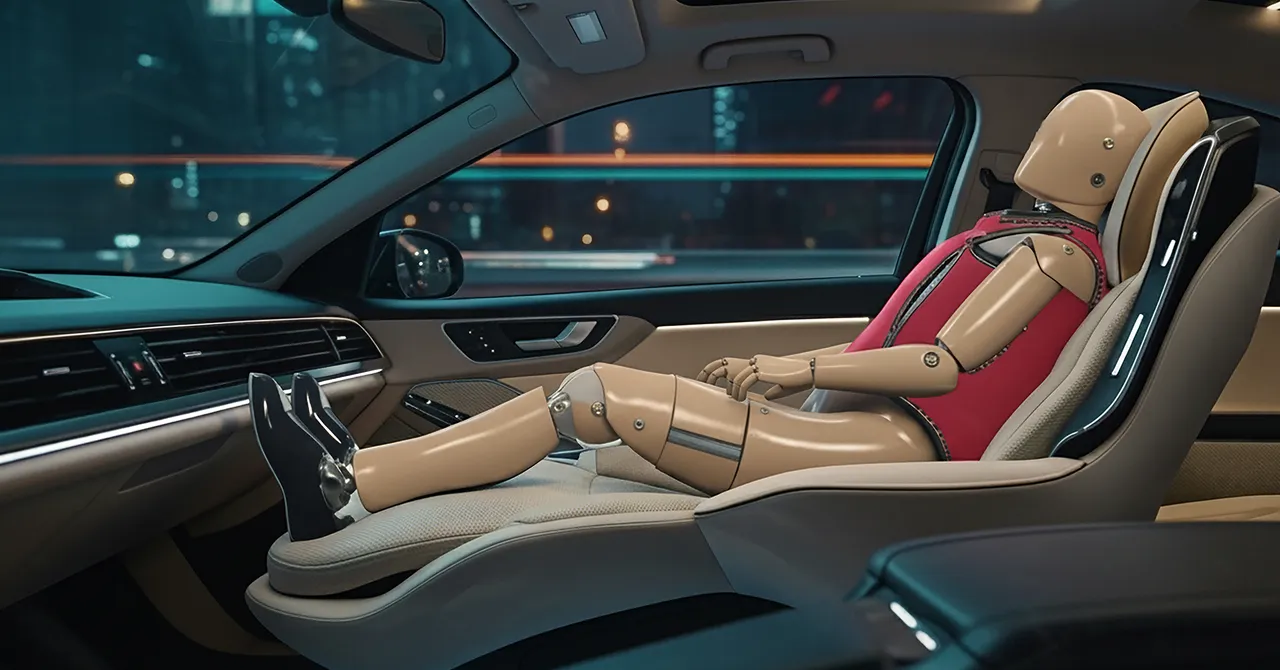
In a video posted on X, a Tesla enthusiast hops into what was once the driver’s seat of a new matte gold Cybercab. “Once” because the vehicle, which officially hit the streets earlier this month as part of Tesla’s Robotaxi ride-hail service, doesn’t have a steering wheel or brake pedals.
For the person in the front seat, this opens up new possibilities. Eat, game, watch, work. Or doze. To help you catch some z’s, the enthusiast demonstrates that the Cybercab’s seats can recline. “You can really go back,” he says. “You can really just sleep here.”
Or maybe don’t. In the official Cybercab rider guide, Tesla says passengers in its autonomous vehicles should keep their seat backs reclined no more than 35 degrees from vertical, with their seatbelts snug across their hips and their feet flat on the floor. Doing so “reduces the risk of injury in a collision or sudden stop.” (Tesla did not respond to WIRED’s questions for this story.)
Safety researchers say Tesla’s right here. In fact, passengers sitting in less-than-standard positions in any car are more likely to get hurt in a crash, even with their seatbelts fastened. According to US federal safety data, 42 people killed in traffic crashes in the past decade were identified as “seat back not in normal upright position, seat back reclined.”
That’s likely an undercount. After a crash, “it’s really hard to identify people who are sitting out of position,” says Becky Mueller, a senior research engineer at the Insurance Institute for Highway Safety. Crashes move human bodies, and emergency responders work quickly to extricate hurt people from damaged vehicles. Very few are noting, or even have a way to note, exactly how victims were sitting before or during a crash.
Field data for reclined occupants is sparse, according to a spokesperson for the US National Highway Traffic Safety Administration, the federal vehicle safety regulator. But the emergence of self-driving cars like the Tesla Cybercab has nudged governments to take a fresh look at an older, dangerous issue.
“NHTSA decided to explore reclined occupants as a starting point for automated vehicle occupant safety based on the potential that occupants may choose to ride in a reclined posture if driving was no longer necessary,” the spokesperson wrote in a statement to WIRED.
A fresh look could take years. The vehicle safety standards automakers must meet today generally assume that vehicle occupants are seated upright, with their seatbelts across their hips. Airbags are configured for people sitting in this way, and the dummies used in crash tests have inflexible pelvises, which means they physically can’t slouch. To create new safety standards, studies must be proposed, funded, completed, and analyzed. Afterward, the government collects public comments from all comers.
“That’s the big excuse: ‘Oh, we can’t revisit this regulation because it’s such a hassle to open it back up, to go through the whole process,” Mueller says. Autonomous vehicles are finally convincing regulators “to open up some of these archaic rules and make modifications—maybe modifications that can help modernize regulations for other vehicles, too. It’s a good time to make sweeping changes.”
Crashing Out

Photograph: Smith Collection/Getty Images
Seatbelts are designed to be worn around upright, forward-facing bodies. So when a reclining body, or one sitting sideways, gets into a traffic crash, the seatbelt doesn’t do what it’s devised to—it tightens around the soft belly instead of the hard, bony pelvis.