




My older sister and I were both named after our grandmothers. She, Rebecca, and me, Kathryn. Becky and Katie. After that, our parents ran out of grandmothers, so they had to get more creative naming our two younger sisters. I always treasured this part of myself, the name that goes back and back, connecting to the many women who carried it. Mothers, daughters.
My sister Becky died on May 14th, 2018. She was sick for a long three years with aggressive cervical cancer, and my life became bifurcated: there is my first life, the person I was before Becky was sick, and there is my second life, the person I am after she died. Those three years of her being sick live in their own intermission, a surprise horror movie, where she dies and the rest of us live on but die in our own ways. Anyone who has lost someone close to cancer knows what this is. Anyone who has had to watch helplessly while hope vanishes knows what this is. A vision of a skin and bones figure on a bed who could not be my sister but was my sister, and then nothing, gone forever. It hurts now as much as it ever did, if I let myself think about it for more than a moment.
I was a new person in many ways after my sister died, but most profoundly, I became a mother a year later. My baby was due in June, but my water broke in the middle of the night a few weeks early. It was Mother’s Day. On the way to the hospital, in the dark, I prayed to Becky. I said please, not May 14th, the same day she died. I cannot bear to lay the weight of all that grief on a tiny baby. But our little girl came out quickly, a mercifully short delivery. It was May 13, 2019. I held my beautiful baby girl in my arms, and I cried for joy and for sadness both.
Love is the greatest force in our lives, it is our greatest happiness and it is what hurts the most. Becoming a mother in the shadow of my greatest sorrow showed me many things. It showed me the strength that I had. It showed me that grief does not have an ending point; rather it is something that makes a space in your life and lives with you day to day. It showed me that grief, although we dread it, is neither good nor bad, and you can make peace with it in your way. You live with it, because it is there, and because you must live. So, you live together.
I had my baby girl, and then another baby boy soon after. By that point, it had been a few years since Becky had died. Every night, my husband and I took turns lying down with the kids to get them to sleep. They never did take to being left in the crib to put themselves to sleep, you had to be there. We didn’t mind. This would take maybe an hour of being still, there in the dark next to a tiny child, listening to them breathe softly, waiting for the moment you can tiptoe out of the room. You know the pattern of the noise they make that lets you know they are really asleep. A sleeping baby can sometimes sound like a soft musical sigh.
Hummmm.
Hummmm.
They were so beautiful, my babies, I sometimes felt overwhelmed with love for them. My heart would ache for them, but they would be right in front of me. Being a parent can be like that. In those quiet hours of the evening, my mind went to a story — to Rebecca. I wrote my children’s book line by line in my head that way, polishing it like a precious gem. I had to put something to words that spoke to everything I felt; I had to write the grief out of myself because I needed to learn to live with it.
But I could not write about Becky directly. I think you can tell even by reading this essay that my sister’s death is still an open wound. Instead, I looked to the name itself. Rebecca, a name passed down here and there, until you go as far back as the 18th century, where you meet the Rebecca of this book. Her name was Rebecca Lombard Smith, and she was our great-great-great-great-grandmother.
Rebecca was pregnant with her last child when her husband David went through the ice by Port Hood Island in March 1789. Most stories recounting this history focus on the father, David — Captain David Smith, a whaling captain. The tragedy of his death is the feature of the story, that he should meet his end in such a devastating way. But to me, it is Rebecca who stands out. It is Rebecca who lives on and raises the children, on a small island off the shore of Cape Breton, all alone. There are many lines of descendants from this family of six sons and one daughter, but mine is from the daughter. It is the mother’s name that came through in my family. It is the mother’s strength I saw in my sister when she fought to live with everything she had in her. It is the strength I found in myself, when I had to.
When Becky was sick, I lived in a house in the village of Port Hood. I could see Port Hood Island out the window. It was lonesome out there among the waves, especially in winter, for no one lives there full time anymore. I was still in Port Hood after Becky died, when I became a mother. I used to look at that island and think of Rebecca. Her children survived, every one of them. My sister’s story ends with loss, but Rebecca’s ended with hope, for all the loss that she endured. I could write that.
I used to strap the baby to me and take the dog, and we would walk as far as I could before my back started straining (baby carriers never did suit me well). It turned out that “as far as I could” was about as far as a place they called the Old Protestant Graveyard and back. This is where Rebecca Lombard Smith is buried.
This is the inscription on her stone:
Here lies the remains of Rebecca Smith who was
born in Truro NEW ENGLAND with her husband
CAPTAIN DAVID SMITH who was lost on the ice
back on Port Hood in the year 1789. Who died on the
30th November A.D. 1821 in the 76th year of her age.
This stone was erected to her memory by her sons
Lewis
Parker
David
I remember thinking Wow, 76, she lived a long time… She lived a lifetime more than her husband… I wonder if it was unusual that her sons wrote their names here, too?… Looking around, I didn’t see any other stone with that kind of personal touch. I don’t have an answer for why they did it, I never will. But to me it seems to be saying, “This is our mother. We loved her.”
Sometimes we ache so much with grief and love that we need to put it to words. I felt connected to these people who lived and died hundreds of years ago. I felt my tie to them as something true. Then I would turn around and walk home, with the dog trotting beside me and the baby strapped to my chest, asleep. The little sound making time with my steps forward.
Hummmm.
Hummmm.
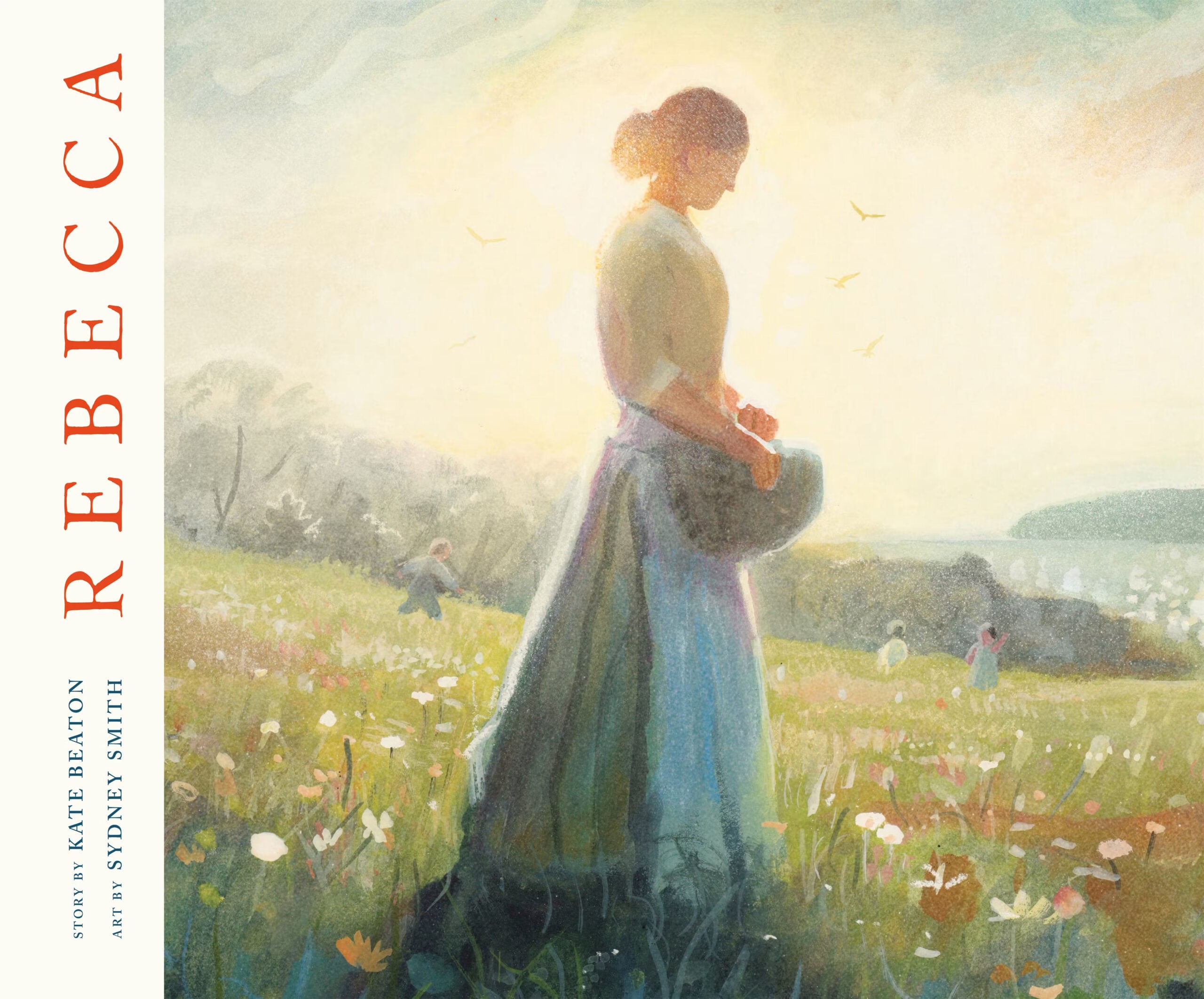
Kate Beaton was born and raised in Cape Breton, Nova Scotia, Canada, where she still lives with her family. She began creating webcomics under the name Hark! A Vagrant and quickly grew a large following. Her two books, Hark! A Vagrant and Step Aside, Pops, are New York Times graphic novel bestsellers. Her new children’s picture book, Rebecca, comes out tomorrow. “My initial reaction to Rebecca was awe,” says Connie Hsu, publishing director of Roaring Brook Press. “My brain began to think about all the usual ‘rules’ about picture book publishing. Here, the main protagonist is an adult, the book is about loss, and two people die in the book! But I just had to publish it.” Find the book here, if you’d like.
P.S. More on grief, including how to write a sympathy note, how to talk to kids about death, and 17 reader comments on loss.
(Top photo by GS Creative/Stocksy.)