



Last year, Peloton did a sweeping refresh of its hardware that added cameras, fans, and AI-powered software called Peloton IQ. This year, it’s zeroing in on its treadmill lineup — refreshing its two existing Treads and adding the new, more affordable Tread Flex into the fold.
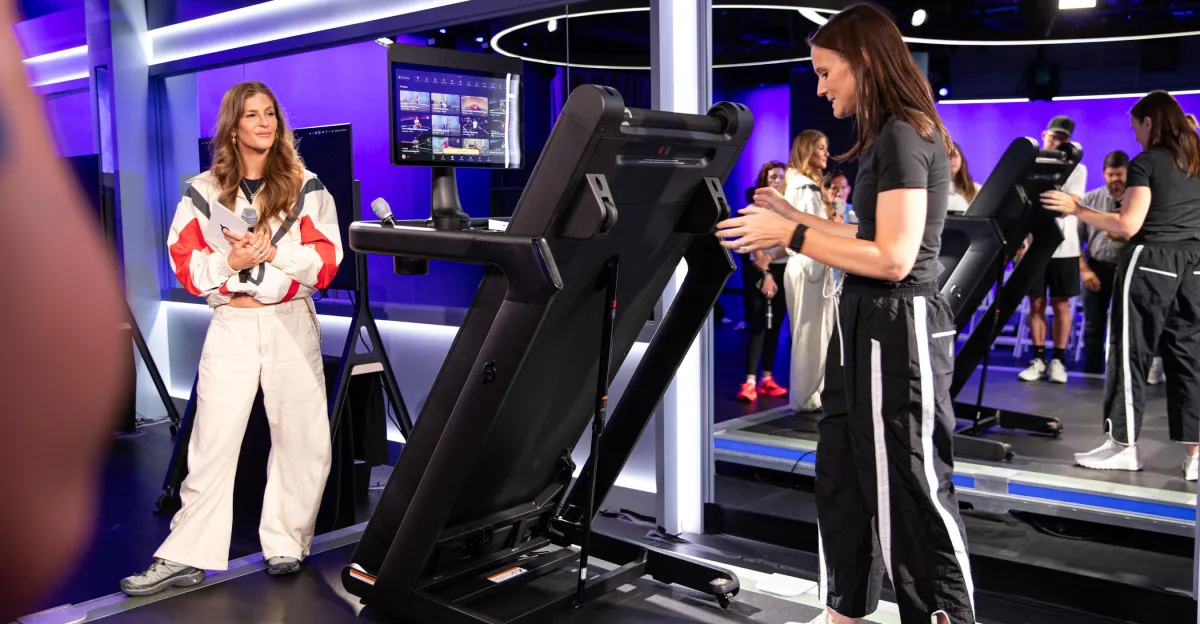
At a New York City launch event, Peloton chief product officer Nick Caldwell told the press the $2,195 Flex — which can be folded upright to save 50 percent more floor space — was meant to address user feedback for a more easily stowed machine. When folded, the Flex purportedly has a smaller overall footprint than the Bike Plus. It also has caster wheels so it can be maneuvered more easily. For safety, the wheels can be locked in place, it has the existing Tread Lock passcode, and it has a slow-opening mechanism using a two-cylinder release. In person, it took about 25 seconds for the deck to lower fully. You don’t have to do anything or push the deck, and there’s no ka-thunk — it just sort of gently falls. That said, Peloton confirmed at the event that there are no sensor-based safety features.

While running, the Flex has a relatively quiet motor at 70 decibels. It’s hard to gauge exactly how quiet it is in a demo space, but it was notably quieter than other treadmills I’ve run on. I don’t think most people will have an issue running on the Flex’s shorter deck, but it might be a concern if you have particularly long legs. Like Peloton’s other treadmills, it has a swivel screen so you can do other types of workouts, but no camera, precluding it from some of the new Peloton IQ features (more on that below).
Meanwhile, its existing two treadmills have been rebranded as the $3,495 Tread Vision and $6,695 Tread Plus Vision. (The former is a $200 price increase, while the latter is the same price.) Here, the upgrades are more refinements. The Vision has a new deck that’s got better cushioning, redesigned jump buttons that let you go up and down for speed / incline, plus a redesigned tray for holding tablets, phones, and water bottles. The Tread Plus Vision also has the new jump buttons, plus a new “sled” mode that may appeal to Hyrox or Crossfit athletes. Both still have a swivel screen and motion tracking cameras that enable some new treadmill-related Peloton IQ features.
As far as software goes, all the treadmills are getting personalized pace. After about 10 running workouts, you’ll get a recommended pace targets that automatically populate within a workout. They may adjust over time as fitness improves. Peloton is also launching a new feature called ReRun, which lets you upload outdoor run course data recorded in the Peloton app or from a smartwatch into the treadmill so you can “re-run” them. That includes automatic incline adjustments based on outdoor elevation on a route. Peloton is partnering with NYRR so that users can “re-run” segments of the New York City Marathon course. At the event, press were told that the company is exploring partnerships for other famous races as well.
For the camera-enabled treadmills, Peloton is adding a running analysis feature. There’s a one-time calibration and then afterward, the movement-tracking camera will run in the background of subsequent workouts. Based on steps, cadence, vertical oscillation, and stride length, users will get a running efficiency score and tips on how to improve their form.
1/9
So far, Peloton’s big bet on refreshed hardware and AI hasn’t translated into earnings. At least, not with its existing user base. That may be why at the event, it seemed Peloton was keen to emphasize who it was hoping to reach with each treadmill. The Flex, for example, was repeatedly referred to as the ideal treadmill for walkers, hikers, and folks living in cramped New York City apartments. Its “cheaper” $2,195 price is also more in line with its bikes, though that’s relative considering you can buy other walking pads and treadmills for much less. On the other end of the spectrum, the Tread Plus Vision was described as the treadmill of choice for performance athletes. The Tread Vision was envisioned for multi-member households who might have people at varying fitness levels. (Various Peloton reps and instructors also pointed out the new redesigned tray as a great option for people who want an alternative to a walking pad — though it’s not possible to hook your laptop up to the display as a second monitor.)
Peloton has repeatedly identified the treadmill space as one it views as ripe for growth in earnings calls. Altogether, it’s clear that Peloton is hoping these new treadmills — but particularly the Flex — might attract new membership signups.