



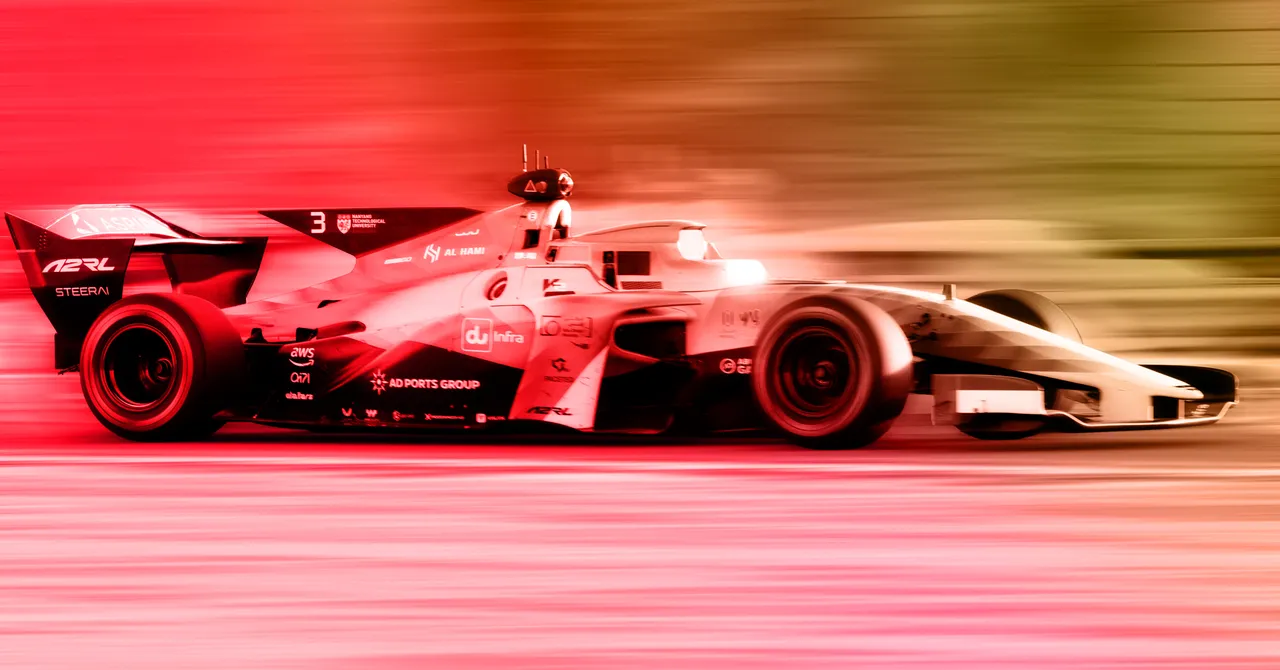
The grandstands erupted with shock as engineers clutched their heads in the paddock. One driverless race car, produced by the company PoliMove, slammed into Unimore’s slowing vehicle in an event held by the Abu Dhabi Autonomous Racing League (A2RL).
At the famous racing track in Imola, Italy, Autodromo Internazionale Enzo e Dino Ferrari, both cars crashed in an area called Rivazza. This is the circuit’s final sequence, made up of corners that are notoriously difficult to navigate. Formula 1 champions have met a similar fate here. But this time, the impact posed no danger to the drivers because there weren’t any.
Launched in 2024, A2RL sought to introduce self-driving cars to the motorsport to test the boundaries of their current capabilities. And this year’s race at Imola revealed those edges, demonstrating of the gap between the computational abilities of autonomous vehicles and their capacity to respond when something goes wrong.
Only two of the five cars in the final completed the race. The UAE’s Kinetiz finished first, followed by Germany’s Constructor Racing. PoliMove clocked in at third place, although its battered entrant had to be replaced for the podium ceremony. Two-time winner TUM withdrew its car after it developed a brake problem during the formation lap.
Participating teams had just nine days of physical testing before the race, in conditions that included rain and hail. This also happened to be the league’s first international competition away from its usual testing ground at Abu Dhabi’s Yas Marina Circuit.
So why choose one of motorsport’s most unforgiving tracks?
“Because everybody can do ‘easy’, right?” says Nicola Palarchi, engineering director at Aspire, the company that founded A2RL. “We have to show we go where it matters.”
Palarchi made it abundantly clear that autonomous racing did not intend to compete with human racing, but rather stay its own motorsport. It could even support the latter.
Because autonomous racing is pitched as more than spectacle: It’s a laboratory with guardrails. Its proponents describe it as a way to test perception, prediction, and vehicle control at extreme speeds without endangering a human driver. These are all factors in the safety of driverless cars in the real world, and so measuring the limits at which these vehicles succeed—or perhaps more importantly fail—can inform future improvements in the technology.
The first hurdle is perception. The vehicle’s sensors identify its location and surroundings, informing planning software that then chooses a trajectory. Finally, the control system translates that decision into steering, acceleration, and braking. Racing makes each of these stages more challenging, since at high speeds, vehicles have less time to interpret incomplete information, predict another car’s movements and execute an evasive maneuver.