



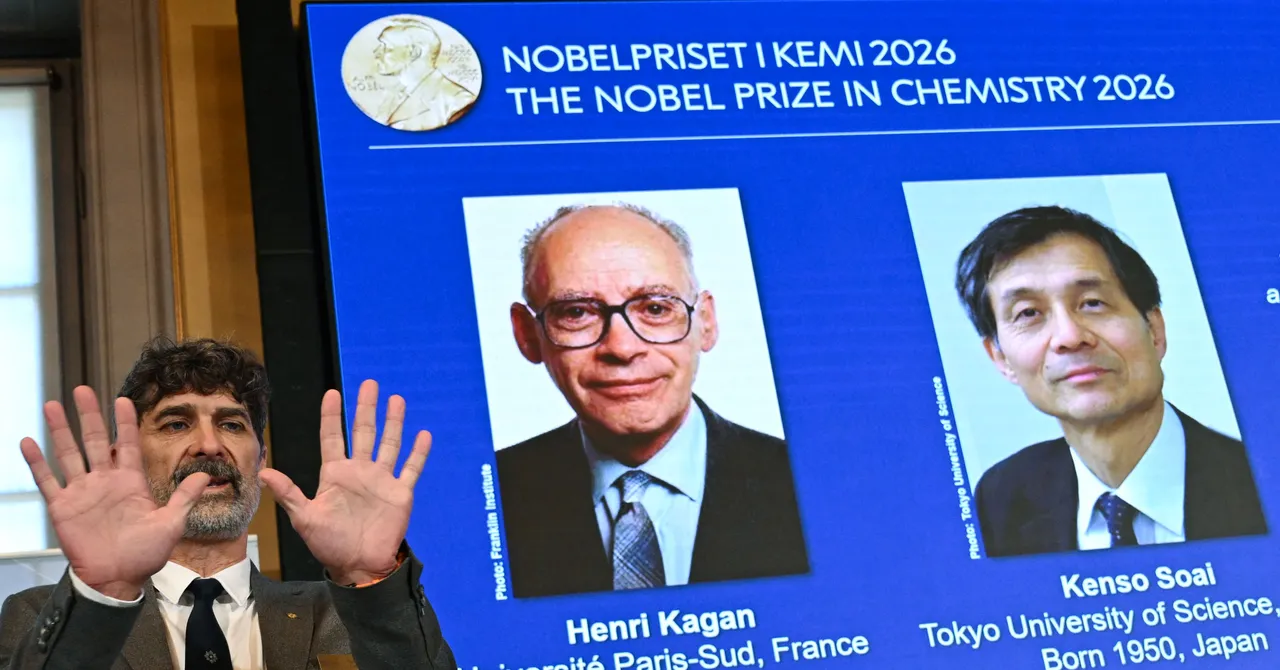
The 2026 Nobel Prize in Chemistry was awarded to Henri Kagan and Kensō Soai for discovering a solution to the enigma of nature’s chemical asymmetry, a finding that opened up new avenues for manipulating the reactions used in manufacturing pharmaceuticals and other materials.
Some molecules are chiral, meaning a molecule has two forms that are mirror images of each other but not identical, like your left and right hand. One of the most mysterious chemical phenomena in biology is that living organisms contain almost exclusively one of the two forms. This is known as homochirality.
Both versions of the molecules—each called an enantiomer—have similar physical properties but can behave differently. The Nobel Committee used a simple analogy to explain this: A locksmith can create two mirror-image keys, but “only one of them fits the lock—and the lock can be damaged if your customers try to unlock it with the other key.”
In the development of new drugs that use, for example, amino acids or sugar molecules as a basis, homochirality poses a problem: While one of the enantiomers of these chiral molecules produces the desired therapeutic effect, the other can cause unnecessary and, at times, harmful side effects. Scientists can’t always easily control which version of the molecule they get out of their synthesis.
The discovery of chiral molecules dates back to the time of Pasteur, who found two enantiomers that reacted very differently when exposed to bacteria. Since then, various researchers have attempted to replicate homochirality in the laboratory with the goal of understanding its spontaneous origin and applying this knowledge to the design of controlled reactions for various purposes. However, early experiments yielded equal amounts of the two variants, failing to reproduce the selectivity observed in nature.
At the beginning of the last century, the German chemist Willy Marckwald designed an asymmetric reaction capable of producing a slightly greater amount of one of the two versions. He achieved this using a chiral catalyst—a substance that facilitates a chemical reaction without being consumed and favors the formation of one of the enantiomers. The ratio between the two variants, however, only changed a little.
Later, in 1953, theoretical physicist Charles Frank proposed a mathematical model that outlined three conditions for reproducing homochirality. First, there must be an asymmetric reaction capable of favoring one of the two versions; that imbalance has to be amplified; and the reaction itself has to produce the catalyst that drives it. This last characteristic is called autocatalysis and generates a kind of positive feedback loop, in which a small initial advantage can cause one of the variants to assemble at an ever-faster rate until it dominates the reaction.
This framework formed the basis of Henri Kagan’s research. Beginning in the early 1980s, he focused on refining asymmetric reactions through a detailed study of the catalyst. At that time, scientists typically used catalysts consisting of a metal atom that acted as the reaction’s driving force and a chiral substance that ensured the process was asymmetric. They assumed that if they used a mixture containing equal amounts of the two versions of that chiral molecule, the result would also be a balanced mixture.