



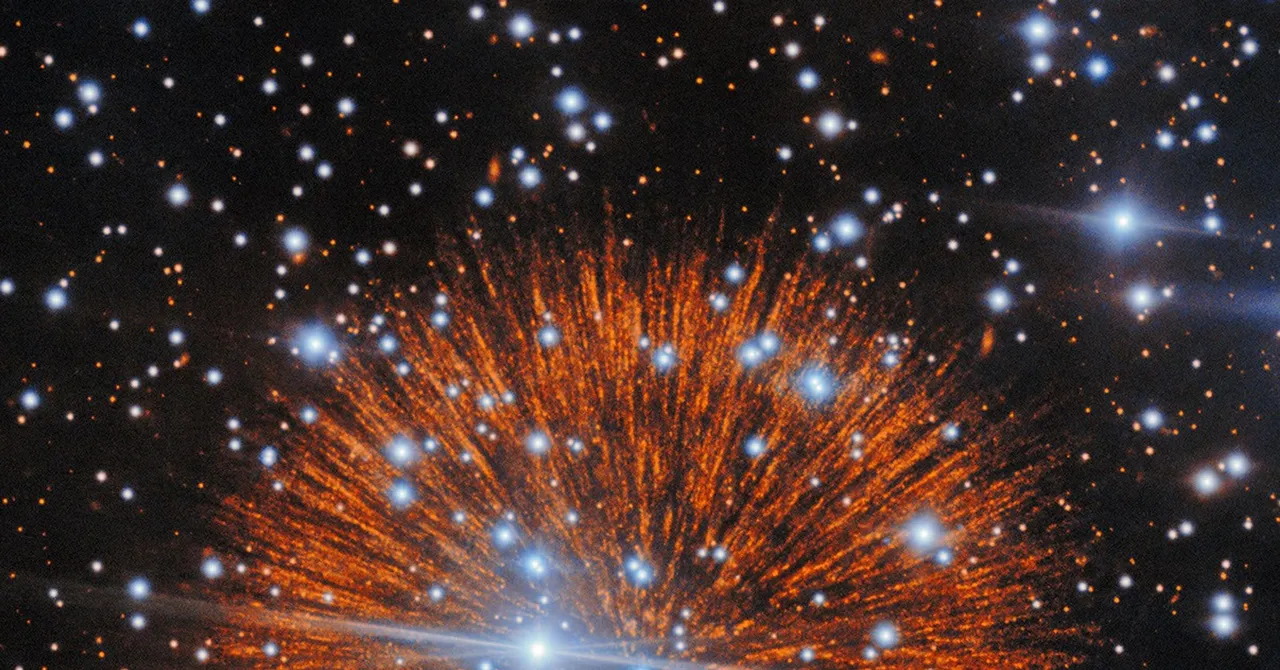
Astronomers have obtained the most detailed image to date of the Pa 30 nebula, the remnants of a supernova famous for having likely been observed and documented from Earth during the Middle Ages. Now, the new photograph reveals structures that had long gone unnoticed.
Previous images of the explosion’s remnants had also captured a sphere of long, filament-like strands of matter that collectively resemble fireworks or a dandelion. The new observations, made with the Gemini North telescope in Hawaii, revealed about 10 times more structures than any previous glimpses of the supernova remnant. With this resolution, researchers can now see that these filaments are not continuous as they had previously appeared. Instead, they’re shaped more like beads on a string, made up of pearl-like knots of gas of relatively uniform size.
These “cosmic pearls” are, in fact, enormous. According to the study published in The Astrophysical Journal, each bead measures about four light-days in diameter. “The planetary region of our solar system could fit in each knot about 10 times with room to spare,” Ilaria Caiazzo, a coauthor of the study, said in a press release. “The knots are quite strikingly uniform. We are excited to try to model them.”
How exactly the pearls formed is not yet entirely clear, though it’s assumed they are concentrations of material ejected during the explosion. What’s strange, however, is their regularity. In the aftermath of a supernova, astronomers expected to find much more oddly shaped accumulations, but the knots are similar in size and appear aligned along the filaments. This peculiar order is a new feature that could help researchers gain a deeper understanding of stellar death.