



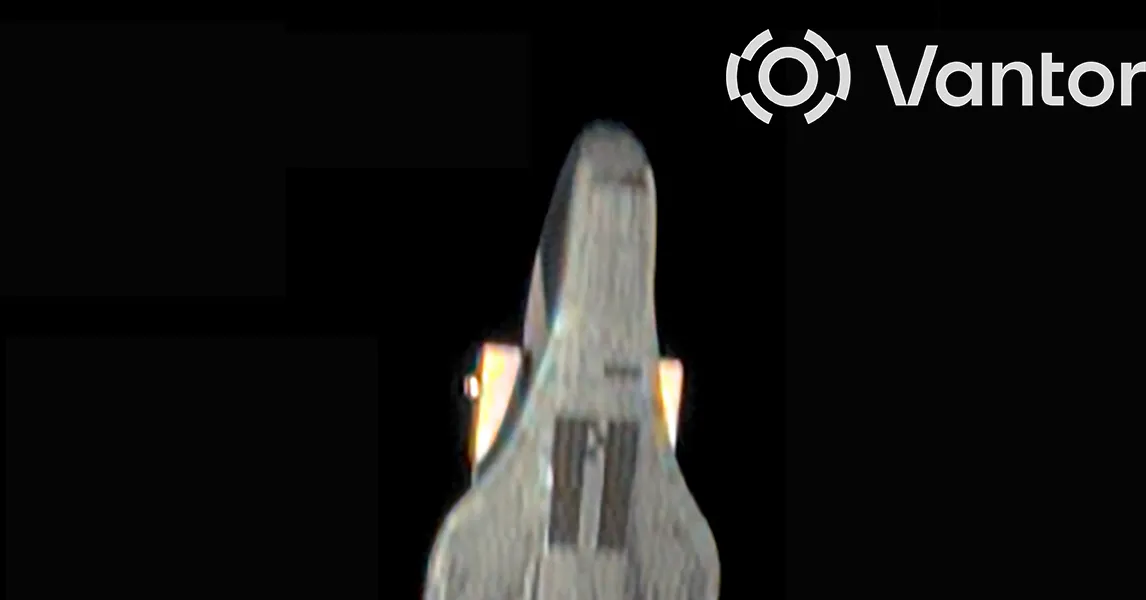
A winged Chinese spacecraft bearing a strong resemblance to the US military’s X-37B spaceplane was photographed in orbit by a passing US-owned commercial satellite in 2024, and we finally have the image.
The Chinese spaceplane has delta wings, payload bay doors, a dark heat shield, and a rear-mounted service module with power-generating solar arrays. In other words, the design of the winged ship is, to a great degree, a copy of the X-37B spaceplane flown by the US Space Force.
The photo was taken by a commercial imaging satellite owned by a company called Vantor, known as Maxar in 2024. Vantor is one of several companies that provide reconnaissance imagery of locations around the world to the US military and US intelligence agencies. The same Earth-imaging satellites can point their telescopes at objects in space.
Lower-resolution views of a Chinese spaceplane showing the vehicle’s general shape were publicly available before the Defense Intelligence Agency assessment. A US Space Force official revealed Maxar’s observation at a 2024 conference in South Korea, but the Pentagon did not release the full-resolution image to the public until Monday, when it appeared in an unclassified DIA assessment of threats to the United States in space.
Catch and Release
The DIA report doesn’t reveal much new about what the Chinese spaceplane does in orbit. China has launched four spaceplane missions since 2020, with durations of up to nine months. The fourth mission is in orbit today after launching in February. It is not publicly known whether China has one or more such spaceplanes in its inventory.
The Space Force has two X-37Bs flying in rotation, with the longest of their eight missions to date running two-and-a-half years from launch until landing. US officials have released photos of the X-37B vehicles, published information about their design and dimensions, and disclosed a handful of experiments they have carried into orbit. Most of the X-37B’s activities in space are classified.
Like the X-37B, China’s spaceplane lifts off inside the payload shroud of a conventional rocket, then operates as a satellite once in orbit. The spaceplane flies like a miniature unpiloted version of NASA’s Space Shuttle and reenters the atmosphere for an autonomous land runway landing at the end of each mission. Ground teams then refurbish it for another flight.
The “enhanced maneuverability” of spaceplanes makes them “more suitable for certain missions than traditional satellites,” the DIA said in its report. So far, the Chinese spaceplane has only flown in low-Earth orbit (LEO) at an altitude of a few hundred miles. One of the Space Force’s X-37B flights soared to an altitude of more than 24,000 miles before using aerobraking to set up for reentry and landing.