



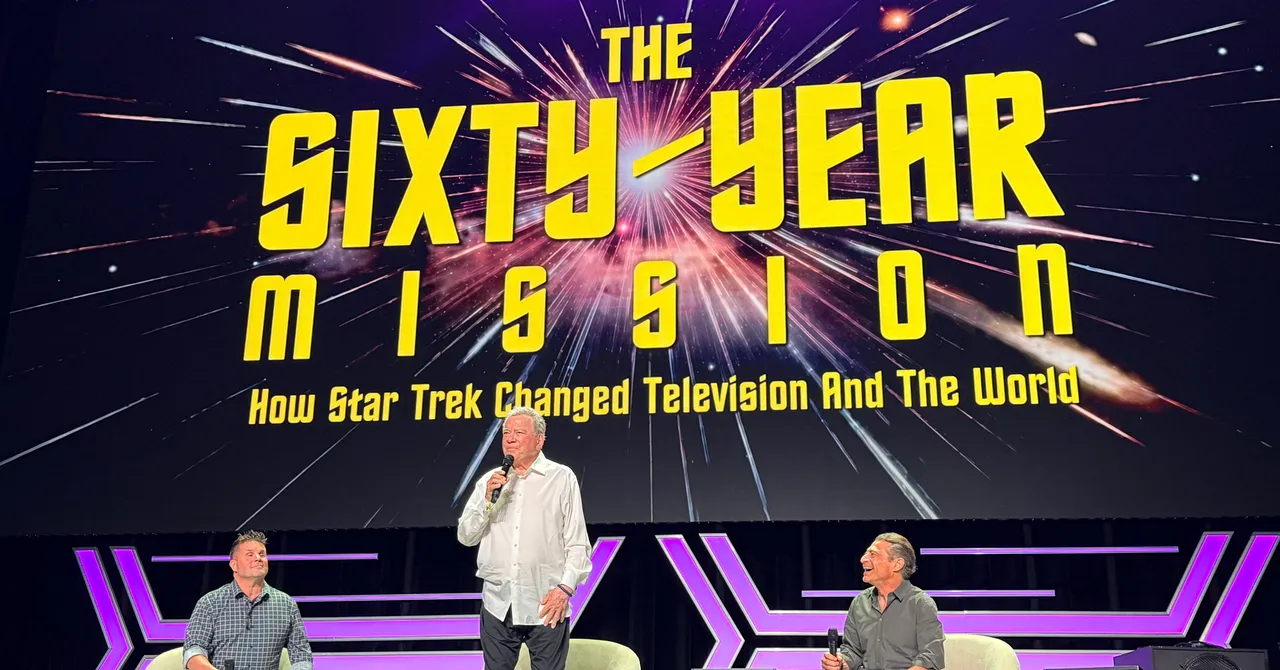
William Shatner wasn’t sure if the audience would approve of his new documentary or not.
When the 95-year-old star took the stage at the Regal Times Square theater for the New York premiere of The Sixty-Year Mission: How Star Trek Changed Television and the World he said “maybe you’ll like it, maybe you won’t.” But, the Captain Kirk actor declared, “you’re going to see a lovely film made by people who cared.”
Focusing on the original Star Trek series, which ran from 1966 to 1969, The Sixty-Year Mission is written and directed by Mark A. Altman, creator of the Inglorious Treksperts podcast. The documentary, which screened during New York Comic Con and hit select theaters this weekend, explores the show’s cultural impact and legacy, and also demonstrates how much it was a product of the political climate of the era in which it was made.
“I think audiences are pleasantly surprised that Sixty-Year Mission shows how the ‘60s shaped Star Trek,” Altman explains. For the film, Altman interviewed dozens of prominent fans and stars, from Shatner and Simon Pegg to Star Trek: The Next Generation stars Jonathan Frakes and Brent Spiner. The president’s niece—and Trek fan—Mary L. Trump praises the show’s pioneering representation, specifically Nichelle Nichols’ Lieutenant Uhura. George Takei, who played Sulu, gives a harrowing account of his time in an internment camp for Japanese Americans during World War II. Others discuss how characters like Spock became heroes for queer fans.
As has been well-documented, these considerations were important for Gene Roddenberry, the show’s creator, who died in 1991. He was a WWII veteran with a progressive bent despite years spent in traditionally conservative spaces like the US Army and the Los Angeles Police Department. Altman insists that “Captain Kirk was ‘JFK: Space Captain,’” and that President Kennedy’s idea of a New Frontier was the final frontier that Trek sought to explore.
Shatner, however, didn’t initially see the show that way at all. “I didn’t think in those terms when they offered me the role,” says Shatner, who served as executive producer on Sixty-Year Mission. “I thought, ‘I got a regular paid job.’ Only later did the magic of Star Trek happen.”
Part of that magic, Shatner adds, is how “Star Trek had an effect on people’s lives.” Those people come from many backgrounds, and the show remained accessible because of the very special tension that existed within its politics, Altman explains. “Roddenberry was liberal on social issues but hard-nosed on defense, and that is absolutely what Star Trek is,” he says. “We need our phasers to defeat the Klingons, but we believe in a diverse crew.”